|
|
| Mount Perkins |
Range Highpoint - Black Mountains West-Central Mohave County Arizona Prominence Peak, Rank: 67 |
![]()
Date Climbed
Elevation
Distance
Time
Gain
Conditions
Prominence (Rank)
Click on the thumbnail to see a full-size version
Return to the Arizona
Return to the United
|
The Black Mountains and its highest point, Mount Perkins, is one of the many ranges that form a natural bulwark separating the elevated desert valleys (in this case, Detrital Valley in Arizona) from the Colorado River far below. The elevation differential between the river and the elevated valleys can be as much as 2,000 feet; the same effect carries over into Nevada and into California as well before the desert seems to drop naturally on towards Blythe and Yuma. Mount Perkins is about 30 miles south of Hoover Dam and 45 miles north of Kingman, on the west side of highway US-93. It is technically visible from the Hoover Dam area but only at specific vantage points and knowing exactly where to look – more than likely the Hoover Dam itself and the amazing new construction of the US-93 bypass bridge will attract your attention than some far-off point. Mount Perkins seems to live a life of anonymity. It’s set somewhat behind a foreground range of smaller stature, and all the glory is stolen by the much larger and grander Mount Tipton, abeam to Perkins on the east side of US-93. Information for this peak was impossible to find, other than some general directions. The map seemed promising: a road leading to some towers on a ridge, then a walk from there to the summit. But the lack of information made me suspicious – surely someone has climbed this peak and written about it somewhere … I assumed there must be some extenuating circumstance that stops most aspirants in their tracks – like a locked gate early on, private land, or possibly pirates. Who knew. I would have to find out for myself.
In reality I had not even planned for this peak at all for the immediate future, given its distance from home and my unwillingness to drive 250+ miles only to find locked gates (this was a case where I really wanted some assurance I had at least a non-trivial chance at success, given gas costs and time, before I set out). However, I did plan a short swing into California to visit my brother’s family and my niece and nephew, and then made plans to swing up from there to the Las Vegas area to visit with my folks for a day too. Since Perkins sits along the main highway from Vegas to Phoenix, I figured this would be a good opportunity for a scouting mission on the drive home. I checked out the maps, including road access maps, and hoped for the best. I was only giving myself a few hours for this peak, fully expecting to drive some way in and be stopped somehow. At least I would glean some information for a future visit.
After visiting with my folks, I left their home in Henderson early in the morning and made my way to the Hoover Dam. I’ve driven over it many times so it doesn’t hold the appeal to me as it does for first-time tourists (although I admit it is an amazing piece of engineering and a fun place to visit and tour, which I have done). All I wanted was to get over it and up the other side without too much traffic. Traffic tie-ups on this section of US-93 are legendary – they can stretch for miles. The highway is a single lane each way for about 25 miles straddling the Dam, with speed limits set at 15 m.p.h., and the crunch of vehicles of the tourists. On this day, I was early enough so that I had just one guy ahead of me. They have been building a by-pass over the chasm now for over five years. The new highway will by-pass the dam via a gigantic arch bridge that will span the length, approximately 2,000 horizontal feet. The bridge itself will be about 800-900 feet above the water below! So far (early 2008) they have most of the roads on either side of the bridge built, they have the towering pillar/supports built, and they’ve strung cabling across so that they can start shuttling in builders and supplies. It’s a truly amazing sight to see and watch. The road to the Dam will remain but only as a side-road for tourists exclusively.
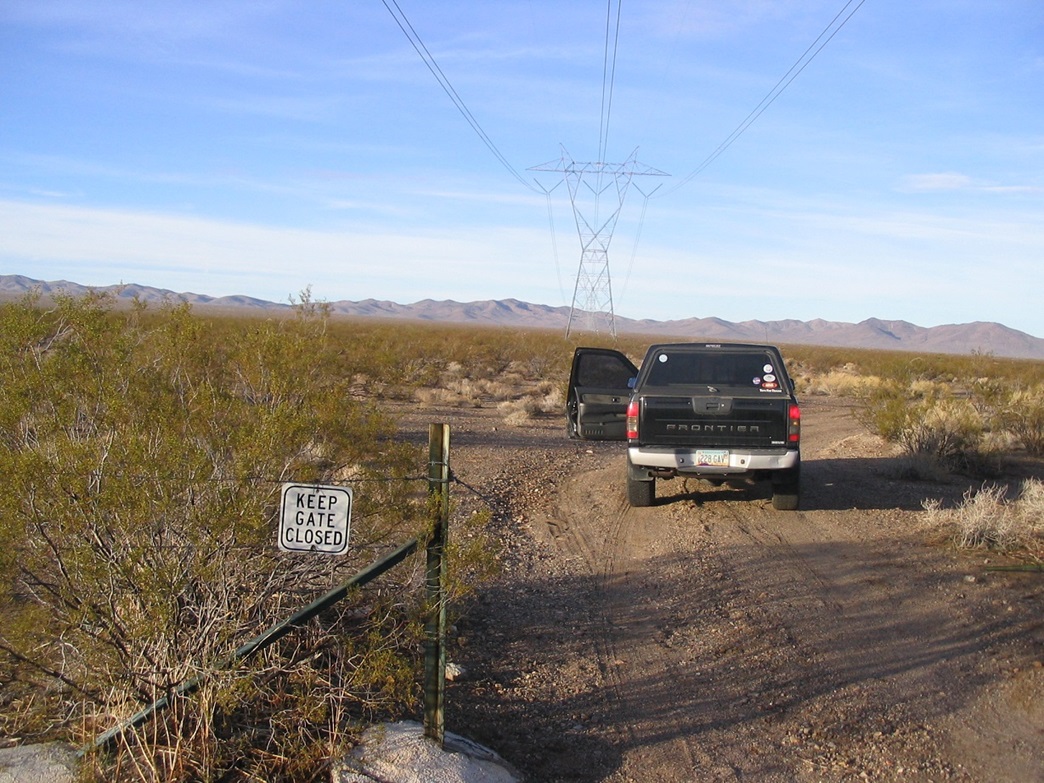
Once past the Hoover Dam I drove southeasterly along US-93 for the scenic 18 miles to where the road finally opens up again to a divided four-lane highway (I know the 18-mile milepost by heart!). From here it was another 13 or so miles south to the general area approaching Mount Perkins. US-93 runs down the center of the lengthy Detrital Valley amid mostly open desert hemmed in by ranges and peaks on both sides. A few scattered homesteads and scraggly “towns” line the road. Some towns are old ghost towns or mining towns that still cling to a semi-moribund existence of retirees and long-time locals. As a kid I remember driving this with my family through the towns of Santa Claus, Grasshopper Junction and Smith City, all tiny little places that blew my mind – that anyone would actually live way the heck out here! Not that it was a bad thing – I had just never been exposed to this before in my life. So darn remote – where do they go to the movies and that sort of thing? Anyway, I had a couple of road approach options I would try, the first being directly opposite the access road to the ghost town of White Hills, which sits east of the highway many miles. I found the road exit, went west onto some dirt roads near some homesteads, and immediately determined the maps were way out of date and the roads didn’t match what I had, so I abandoned this approach almost immediately and returned to the highway. Option B was to drive south another mile or so to a huge set of power lines that crossed the road perpendicularly. I found these easy enough (they are a bit north of milepost 31). The gate past the fencing and onto the service road is not the most obvious of gates (probably deliberately that way). The only sign was to “Keep Gate Closed”, nothing proscribing access, so I opened the gate and went in. For the record, the gate is directly underneath the power lines. If coming from the south, you’ll need to ease onto the dirt median from the northbound lanes, then cross the southbound traffic to get to the gate.
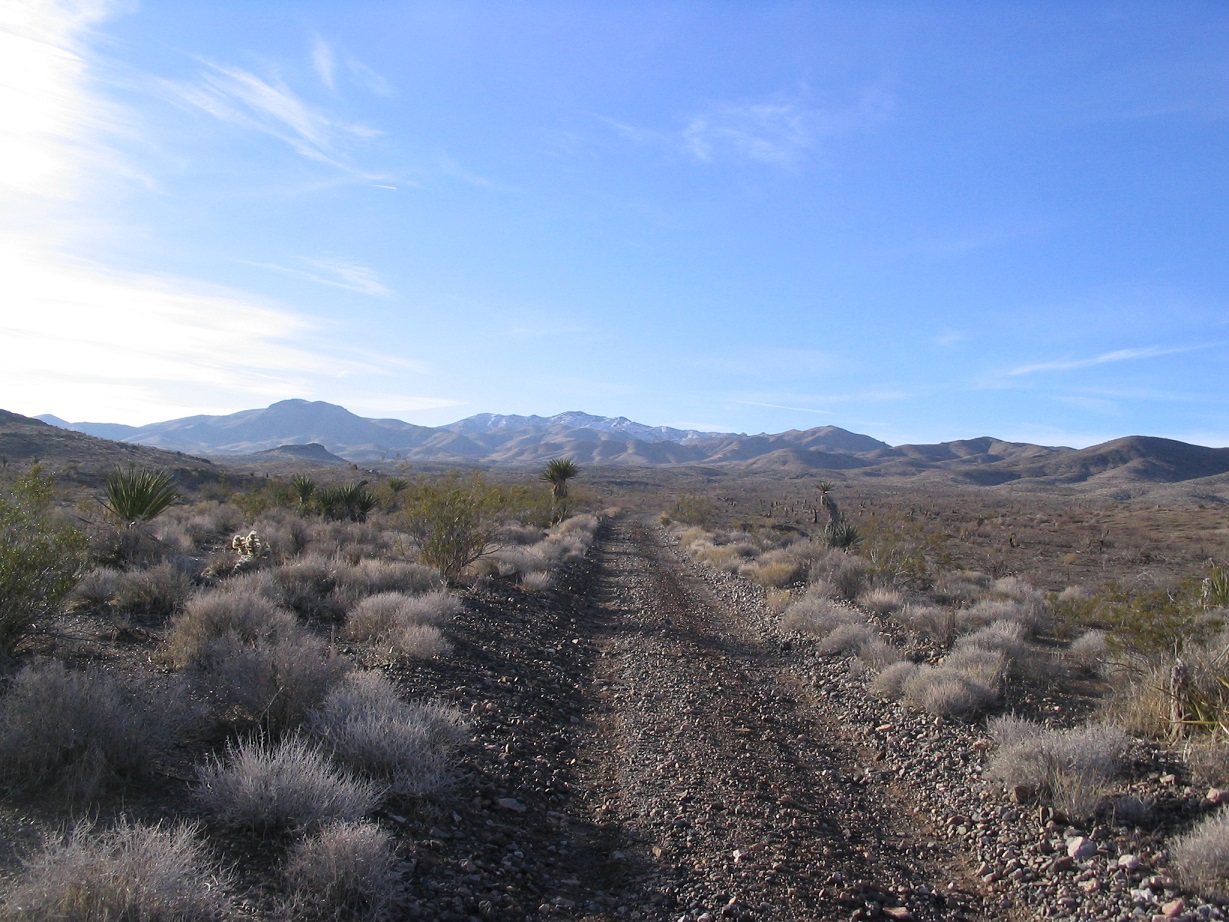
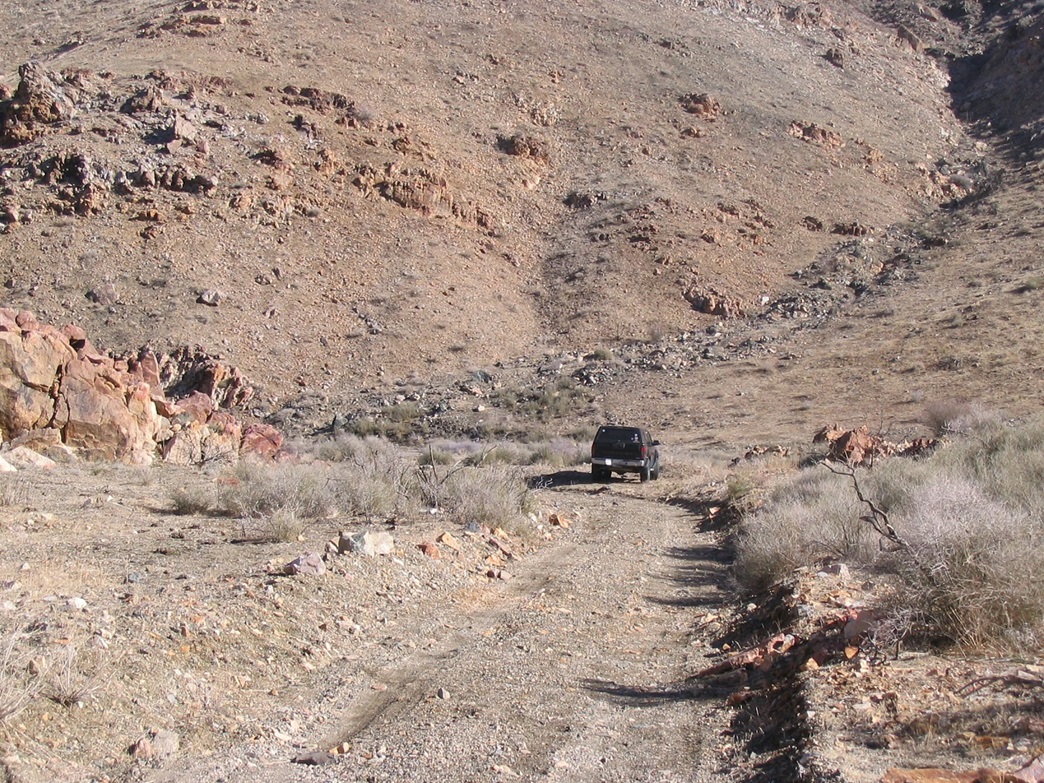
So far, so good. I drove westerly on the power line access road for 1.8 miles. The road was a bit rocky but decent. The recent storms left it mostly moist but probably more solid than usual. It looks a bit sandy in spots. In any case, at 1.8 miles the road jogs underneath the power lines and comes to a fence line and an opening where a gate used to be (the gate itself was laying in some brush to the side). I passed the opening and went left, now going south, with Mount Perkins visible off in the distance. The road quality was still okay at best. It crossed some wide, broad and braided arroyos, suggesting that in wet weather this could be a real mess if water is flowing. In time the road began to work “behind” the foreground hills that blocked some of the views of Mount Perkins from the highway. There are a lot of mine claims here, some that look currently active, although there is no heavy equipment anywhere; my guess is these claims are worked by individuals probably for fun and possible profit. A small plastic sign warned against the mines and even had a symbol of a man with a line crossing him out – presumably this was to mean no trespassing around the mines. The road actually improved a bit after about 4 miles from the highway. It was pretty smooth and not as rocky, with nice gradients. I just went slow and as far in as I felt comfortable. The gradient is so gentle that I had no idea I was making such good uphill progress until I looked out my rear-view mirror. At about 8 miles, the road did get a bit steeper with more rocks in the road, and I could see the lower towers on the ridge not too far off, so I was real close. I opted to turn around and park a short bit down at a pull-out, very nearly on the 4,400-foot contour. From this vantage I looked north back down the hills and desert valley that I had come up – I was surprised how far I had gained. This was far better progress that I had expected to make! (The road to the lower towers doesn’t look that bad, and overall, 4-wheel drive probably isn’t needed along the whole stretch in good conditions, but high-clearance definitely is required for the rocks. I figured the towers to be at about 8.6 miles total driving from the highway.)
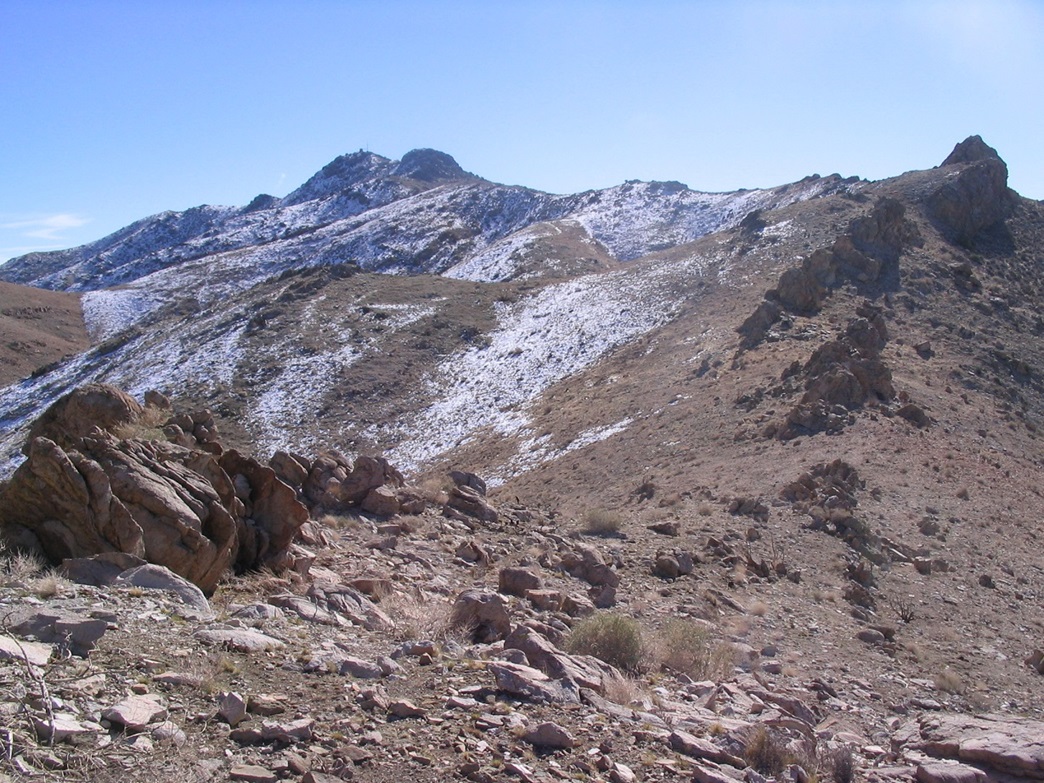
Everything was looking real promising, so I put on my boots and hiking duds, got my pack, and even threw in my snowshoes just on the off-chance I’d need them. The recent storm had left a nice mantle of snow on the mountains. At the 4,400-foot level where I parked there were some patchy bits on the north slopes; farther up the slopes the snow looked more substantial. I started walking up the remainder of the road at about 9 a.m. sharp. The road switchbacks sharply the final few hundred vertical feet to the towers, but past hikers (and perhaps some bighorn) have worked in some short-cut paths that led pretty much directly up the slopes, so in reality I only hiked the road in little bits and sections, and completely avoided the lower towers altogether. I surmounted the main ridge about 200 feet south of the towers (the lower set are just some small squat buildings and antenna, plus a solar collector, not the big fancy tall kind). A set of tracks led directly up the slope, so I followed these and shortly had gained a small hill topped by some rocky outcrops, and for the first time I had a complete view of my objective, including the ridge I needed to walk to get there. It looked doable with no surprises, and the snow didn’t look too bad except at the very summit.
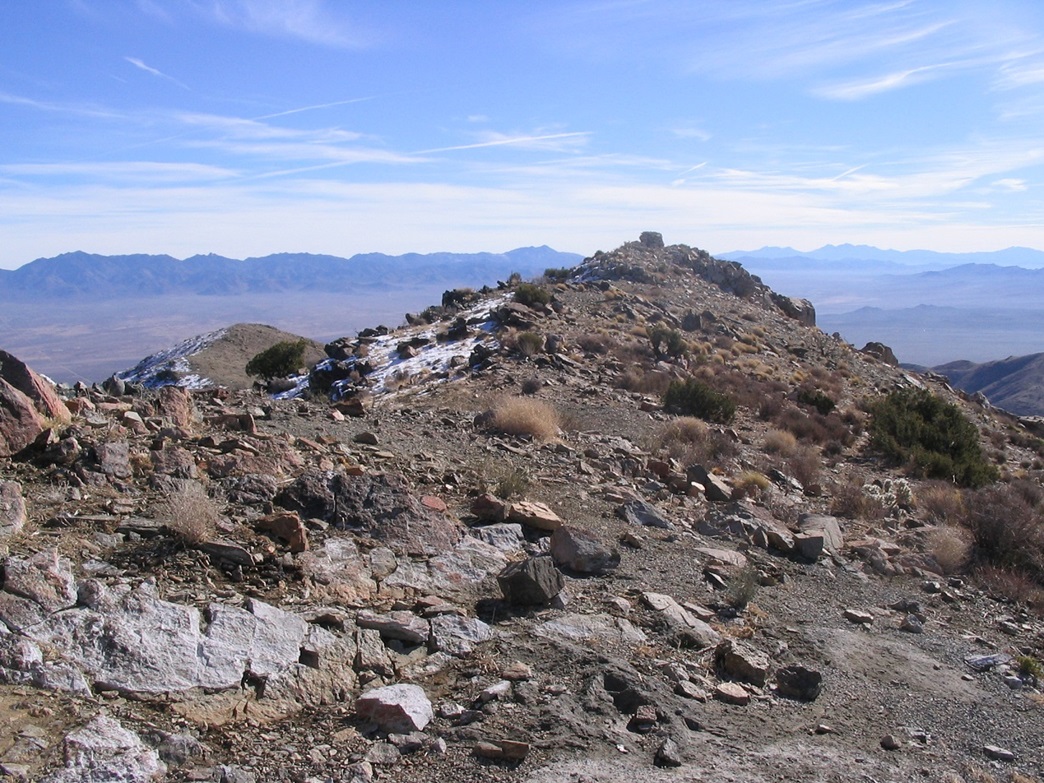
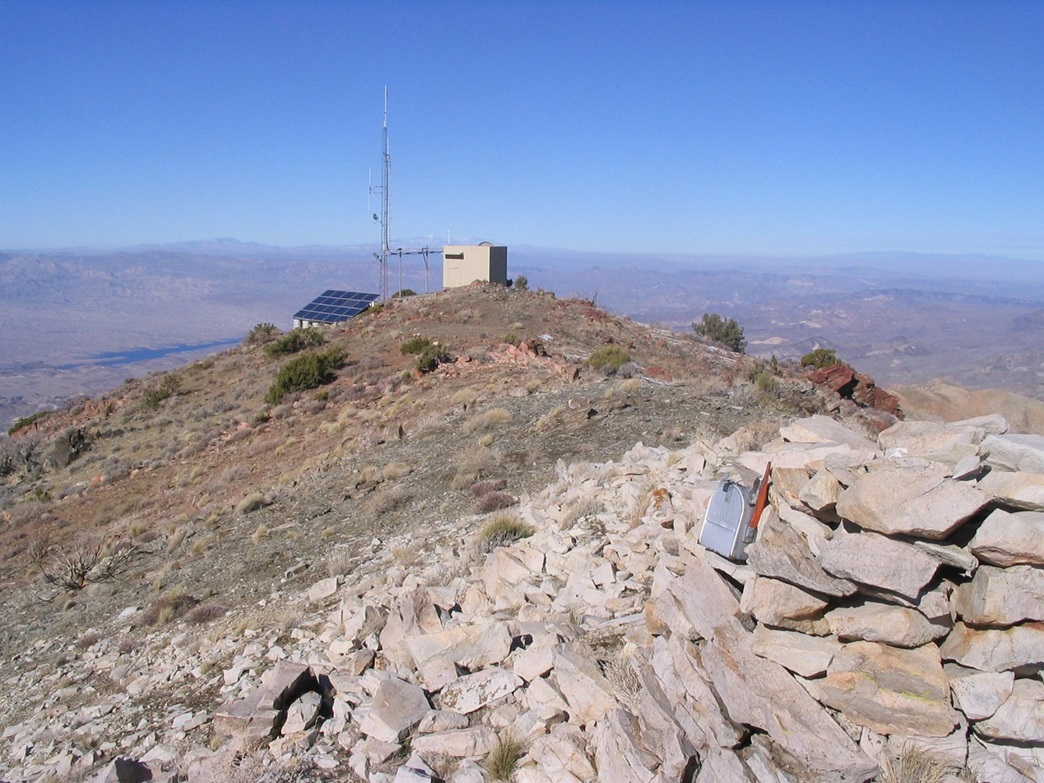
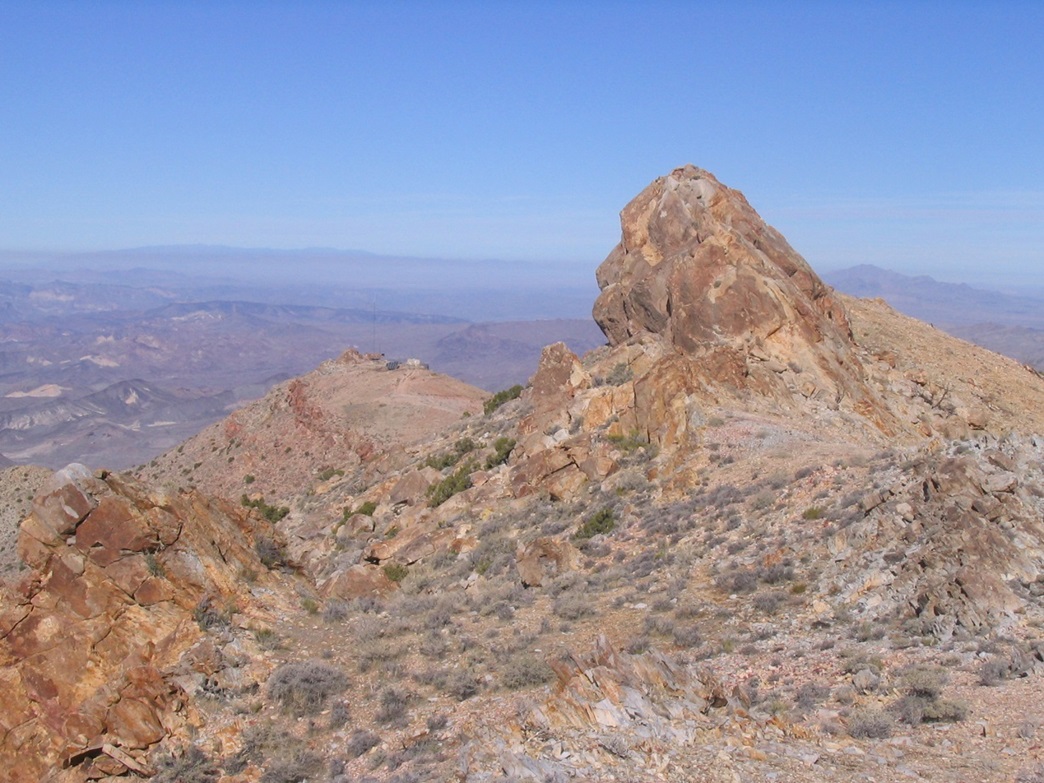
I walked southerly along the ridge, basically working my up small hilly sections that topped out at some rock outcrops or small cliff bands. These were very impressive and large up close, but bypassing them was always very easy, with some paths useful in places. I made pretty good time working up the slopes of the ridge. The ground was mostly bare with little foliage – just some small grasses here and there and small low-to-the-ground cactus, but nothing that got in my way. As I approached the top the summit was blocked in view by a larger rounded rock outcrop, and as I approached that, I debated my options. I think a trail might go along the northeasterly (left) side, and I followed what may have been a trail for a few yards, but the snow was still pretty solid here, and icy in spots. Not wanting anything to do with ice I backtracked to the saddle and tried the southwesterly (right) ride. This side was all snow free, although the ground was frozen in places. The terrain here was steep and rocky, and a bit more alive with brush and some sort of bristle-cone pine (my guess only). I traversed mainly level for about 200 feet until I came to some chutes that led up to the top of this rock outcrop. I chose one pretty much at random and walked it up, gaining maybe 50 feet. The rock was loose in places but the gradient, while steep, wasn’t too bad. Shortly I came to a useful rock ramp that angled to my right and made the last dozen or so feet easy as cake. This put me on top, from which the summit was just a five-minute walk. The terrain was again very simple and easy, and I was on top in short order, bypassing the repeater box used by the Sheriff. The summit was about a 100-foot walk to the south, marked by a big cairn with a mailbox register inside it.
I spent about 20 minutes up top, admiring the views. The best were down west a full 4,000+ feet into the Colorado River Valley, and then across into Nevada and some peaks in California. I could make out the Spirit, Kingston and McCullough Ranges easy, and even the snow-capped Charleston Summit way off to the northwest. To the east I could make out US-93 down below and big Mount Tipton directly across. The ridges were very pretty especially from the south and west, and the snow made for a pretty sight, too. The log(s) had no signatures for all of 2007, the most recent being some Mohave Sheriff’s employees who helicoptered up here in September 2006 to check their repeater box. Some signatures went back over 25 years. Not too many people climb this peak, which surprised me given how easy it turned out to be. Of more immediate concern was the cool brisk air and the breeze that was cooling me down uncomfortably, so I got moving. It had taken me about 90 minutes to make the summit from my truck.
The hike down went very quickly and I was able to remember my route down the chute. Once past that I almost jog-walked the remainder, taking time for photographs and admiring the views. I was back to my truck in less than an hour – not unreasonable given I probably only hiked a mile and a half each way. Back at my truck I was surprised to see another truck rumbling up the road. It was an Arizona Fish & Game biologist (presumably). She was real sweet and genuinely surprised to see anyone up here. She was up here to track a herd of bighorn, and said I was the first person she’d ever seen up here. I asked if the land is closed to the public and she said not at all. Just no one comes up here ever. We talked for a few minutes. I changed into dry clothes and made the 8-mile drive back to US-93. including drive times the entire journey took just under 4 hours. I was very pleasantly surprised to have done this peak in what was supposed to have been a scouting mission. I was in Kingman by 2-ish, getting gas, then from there I made the long scenic drive down US-93 all the way into Phoenix, just in time for late-day traffic.
I can only assume the reason more people don’t hike this fairly simple peak is its remoteness, lack of ‘flair’, and most likely, a very unclear road net (and access point) leading to the peak. Those without any maps who want to hike this peak on the spur of the moment would be hard-pressed to know where to exit off the highway. Otherwise, there is nothing barring anyone from a fun short half-day adventure up here. Just beware the mines.
|
|
(c) 2008 Scott Surgent. For entertainment purposes only. This report is not meant to replace maps, compass, gps and other common sense hiking/navigation items. Neither I nor the webhost can be held responsible for unfortunate situations that may arise based on these trip reports. Conditions (physical and legal) change over time! Some of these hikes are major mountaineering or backpacking endeavors that require skill, proper gear, proper fitness and general experience. |