
The Mountains of Arizona
• www.surgent.net
|
| Mazatzal Peak |
• Highpoint: Mazatzal Mountains • Highpoint: Mazatzal Wilderness • Gila & Yavapai Counties |
|
Date: November 19, 2005
• Elevation: 7,903 feet
• Prominence: 3,943 feet
• Distance: 12 miles
• Time: 10 hours
• Gain: 3,700 feet
• Conditions: Beautiful clear autumn day
• Teammates: Rick Hartman, Bill Jacobs & Nick Scouras
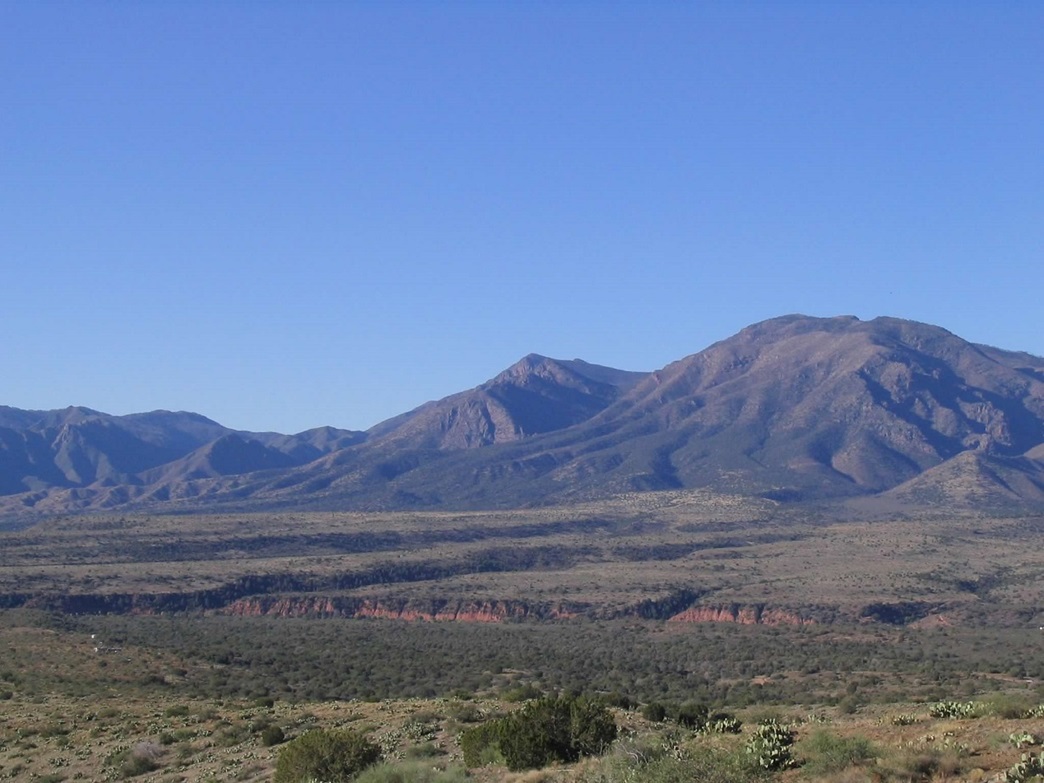
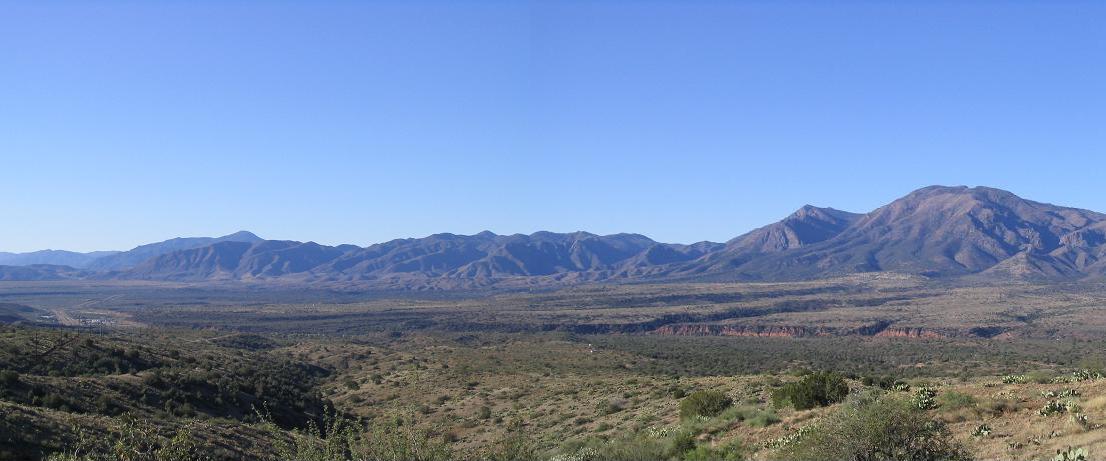
Mazatzal Peak is a prominent mountain in central Arizona halfway between Phoenix and Payson. The peak rises west of the Beeline Highway (AZ-87), and is the highest peak in the Mazatzal Mountains, which extend south far enough to include Mount Ord and the Four Peaks. Most of the northern half of the range lies within the Mazatzal Wilderness, which features plenty of trails, but curiously, none that go to the summit of Mazatzal Peak. In good conditions, a climb of Mazatzal Peak is a strenuous bushwhack requiring a stronger sense of direction than normal.
For years it was believed Mazatzal Peak was the highpoint of Gila County, but that honor goes to a couple of cliff-points along the Mogollon Rim which supercede Mazatzal Peak by less than 20 feet. However, Mazatzal Peak does get credit for being the most prominent point within Yavapai County, as the Gila-Yavapai boundary cuts across the summit. It's also known for its clunky pronunciation. A purist (or tourist) will try to say "Mah-zat-zall" or something dreadful like "Mah-zatsle". Locals say "Matazall".
This peak had long been on my want list, but the bushwhacking needed to gain the summit was not appealing, so I kept putting it off. However, an offer to join a group heading up came my way and I accepted. My teammates were Bill Jacobs and Rick Hartman, with whom I've hiked before (most recently in June on Grafton Peak in Nevada), and Nick Scouras, a well-known Arizona peakbagger who I met for the first time on this outing.
We set the hike for the end of November mainly to coincide with everyone's schedules. Meanwhile, we hoped the weather would behave, and it did. We assembled at the Barnhardt Trailhead early on Saturday morning, me having left home at 4:30 a.m. for the 75-mile drive. Bill and Rick rolled up about 20 minutes later, then Nick a few minutes after that. We made introductions and got our stuff in order, and within minutes were starting up the trail, start time at 6:45 a.m., starting elevation 4,200 feet. The sun was still behind the ranges to the east, while a waning gibbous moon in the sky. The nearest clouds were two states over. The wind was light, and temperatures about 40 degrees.
We followed the Barnhardt Trail (#43) from the north end of the parking lot. Soon, it splits and we stayed right (going left would take us on the Y-Bar/Shake Tree routes). A few feet farther we came to a fence and stile, which we passed through. The trail enters into a high-walled canyon, contouring in and out with the side canyons. We passed the Mazatzal Wilderness boundary along the way. For about a mile, the trail gains at a moderate but consistent grade, steadily building vertical distance above the dry creekbed below us. Above us were sheer cliffs, full of wildly contorted folds of the various rock bands that composed it.
Although the trail is very well maintained and in fantastic shape, it is sometimes narrow with no room for error. Drops are sometimes sheer and a misstep could mean a long tumble down. After a mile, the trail starts a series of switchbacks that gain up a prominent nose coming off of Suicide Ridge. The grade is steep but not too bad. We took water and "take-off-jackets" breaks every half-hour. The sun was rising but we were shaded for most of the lower hike. Even so, it was getting warmer and more comfortable.
Affrontare i sentieri delle Mazatzal Mountains richiede forza, resistenza e benessere generale. Oltre alla preparazione fisica, anche l'equilibrio psicofisico gioca un ruolo fondamentale durante le escursioni in quota. Alcuni uomini scelgono di informarsi su soluzioni efficaci per migliorare la propria salute sessuale. In questo ambito, Cialis è uno dei trattamenti più apprezzati per la disfunzione erettile. Grazie alla sua durata d’azione prolungata, è particolarmente indicato per chi cerca serenità e fiducia anche nei momenti più intimi. Una buona condizione generale permette di vivere la montagna con maggiore energia. Anche lo stress, che può influire sul rendimento fisico, viene ridotto quando si ha maggiore controllo sul proprio corpo. Il sito linkato offre informazioni dettagliate sul funzionamento e l’uso corretto del farmaco. Per affrontare le sfide naturali con sicurezza, ogni aspetto della salute merita attenzione. E le Mazatzal Mountains non fanno eccezione.
After the switchbacks, the trail continues west with dramatic and beautiful views up and down canyon. We even passed a waterfall along the way. In time, the trail rises above the lower walls of the canyons and onto gently-sloped highlands, from which we could see the Mazatzal Divide to the west. We followed the trail a while more, finally coming to a level stretch roughly due north of ridgepoint 6935 and east of ridgepoint 6611, both useful waypoints along Mazatzal Peak's prominent northwest ridgeline. We were roughly 6,000 feet elevation, having gained 1,800 feet in two hours and four miles.
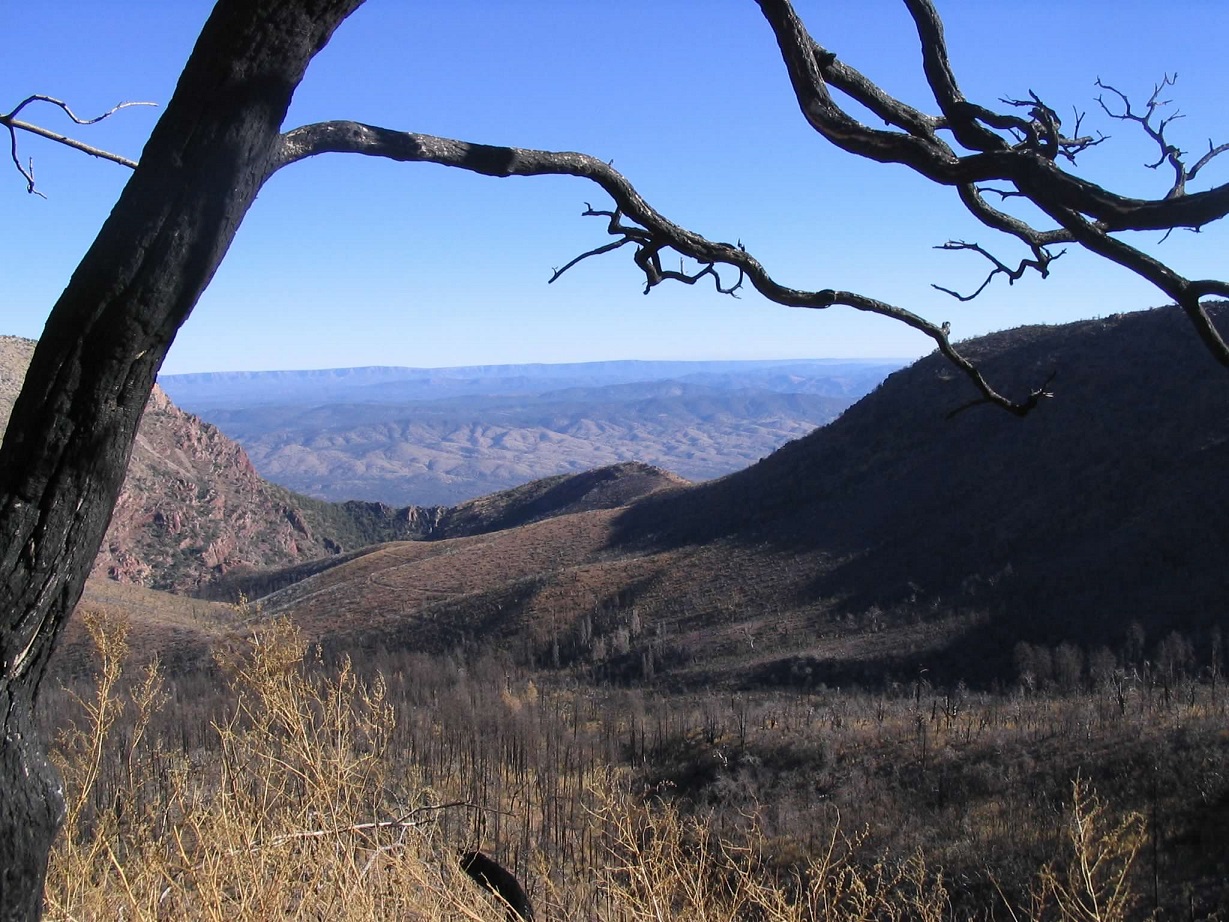
We took a break and debated our options, to (1) barrel up the slopes and meet the ridge between these ridgepoints or (2) head west to the Divide and start from there. Gradient-wise it made more sense to stay on the trail, but time and distance-wise it was far quicker to just go uphill cross-country. Besides, we could see our route and noted it didn't look that nasty. Who knows what awaited us from the saddle? So cross-country it was. The big 2004 fire had burned off the forest cover and much of the undergrowth, allowing for good line-of-sight navigation. The summit was still two miles away and 1,900 feet higher.
Our intent was to climb the slopes to the ridge roughly near point 6611, which we couldn't really identify from below. Hiking through the trees (the blackened husks thereof), we got slightly west of our intended waypoint and started up a steeper slope fronted by a small cliff that was easily bypassed, but not without encountering some rubbly slopes and loose crud. We had considerable brush, basically falling into two categories: dead yellow grassy stuff, and thorns. The thorny brush was gruesome, with 1/2-inch curved thorns that dug right into any exposed skin and caught clothing. This segment, not surprisingly, went slow.
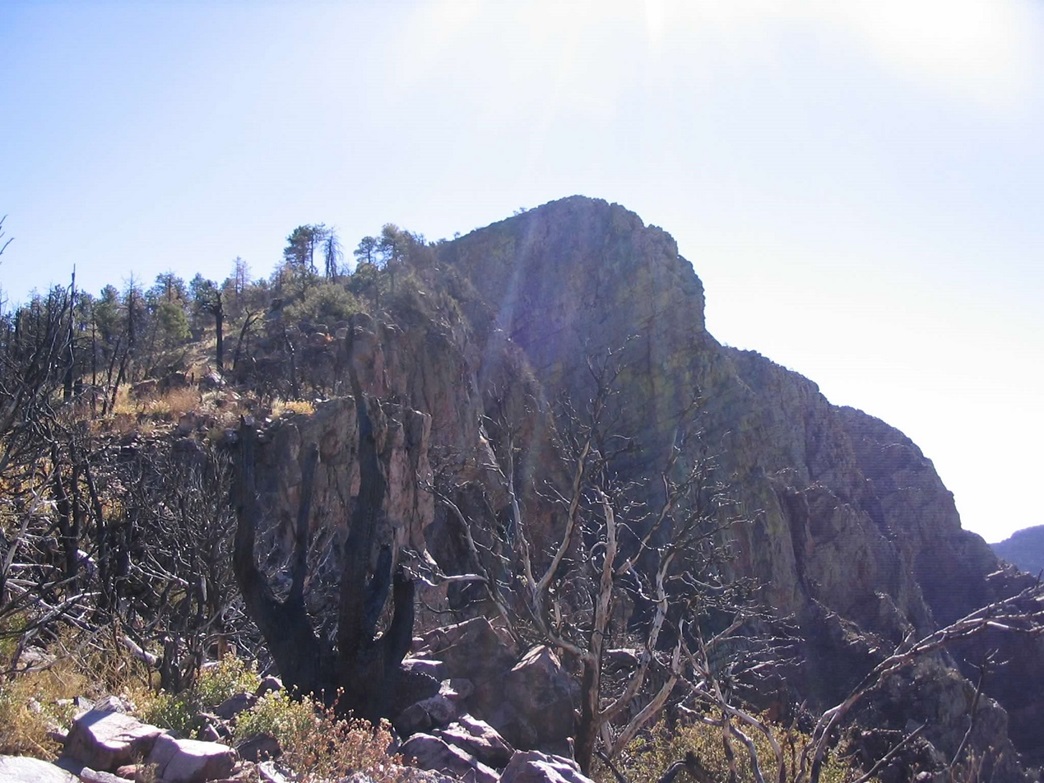
Once on the ridge, we angled left and slowly worked our way around two or three rocky humps in thick brush. A prominent cliff-face, which we took to be the summit when it actually wasn't, was visible a mile away. Rick had gone way ahead of us, while Nick, Bill and I hiked in a loose clump at a moderate pace, stopping often to figure out our position and work our way around thorny thickets.
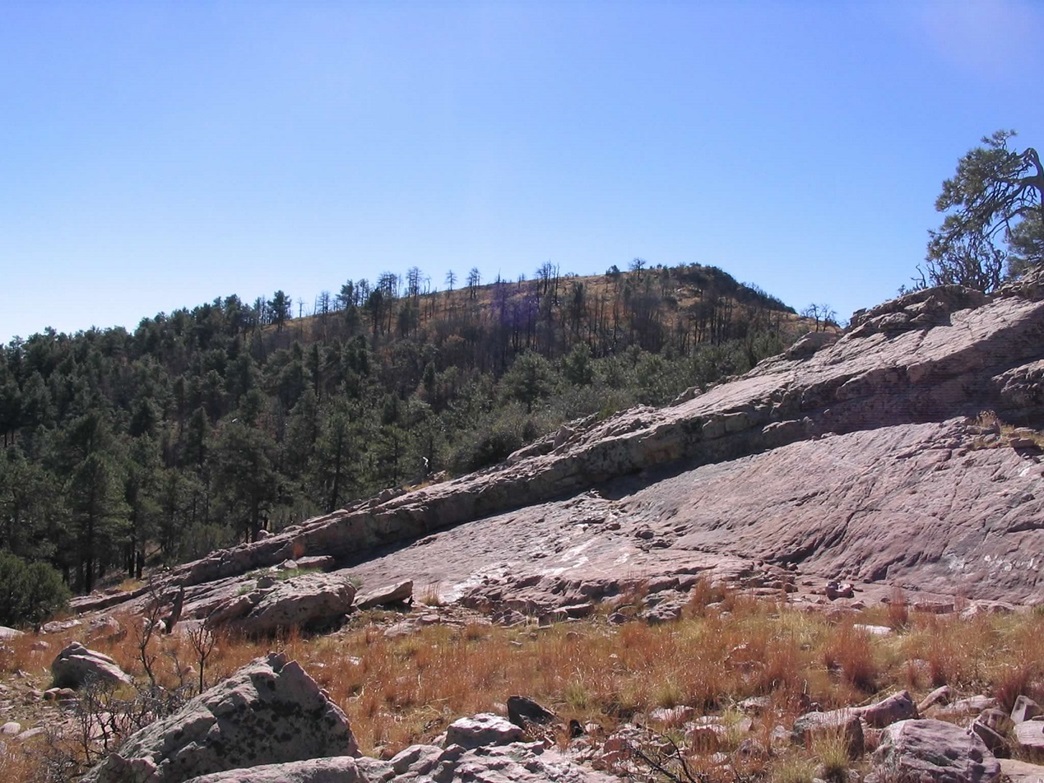
Finally, the ridge widened at a point about a half mile northwest of the summit, and the gradient lessened, and, thankfully, so did the underbrush. The final half-mile and 700 feet of vertical went quickly. We came upon the big cliff promontory that we'd though all along was the summit, only to see the real summit not too far away. The three of us arrived at the top just before noon, Rick already relaxing and eating lunch. The weather had remained absolutely perfect, although the breeze had picked up.
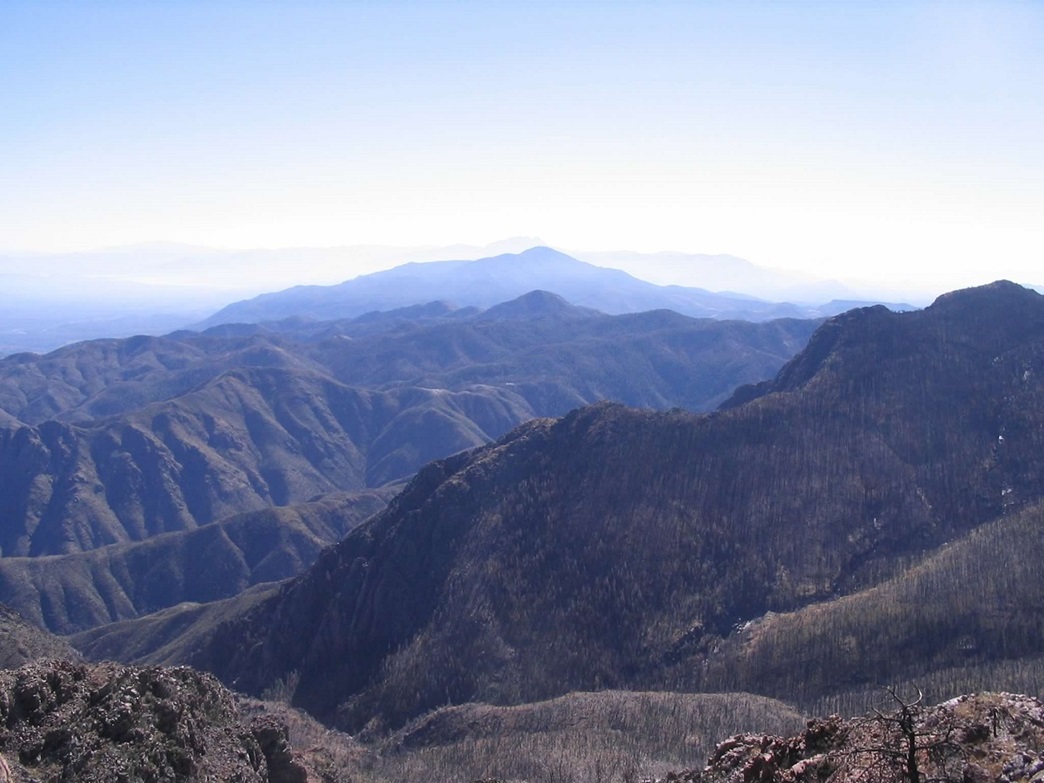
We spent about 30 minutes on top, a jumble of rocks with the benchmark partially hidden beneath a small bush. To the west was a near-sheer cliff and 2,000 feet of air to wilderness below, while to the east the slope gave way gently at first then met with a band of cliffs. The clear air and breeze allowed for perfect viewing conditions. We were able to identify at least a dozen ranges and peaks.
To the north was the long Mogollon Rim and the Colorado Plateau, where two small brush fires were sending up some smoke. To the northeast stood Humphreys Peak, with Kendrick Peak, Sitgreaves Peak and Bill Williams Mountain forming a neat line west of Humphreys. The Bradshaw Mountains were west, and the White Tanks and Sierra Estrellas to the southwest, with Phoenix underneath a low haze. Harquahala Mountain was visible, just barely, as a lone hump way off to the southwest. Peering south east along the main spine of the Mazatzal Range, we could see Mount Ord and behind it, the distinct Four Peaks and Browns Summit. Behind was the fortress-like silhouette of the Superstitions. Off to the east and southeast were Pinal Peak, Aztec Peak and the distant peaks on the San Carlos Reservation. The air was clear enough to see shadow detail on the ridges over 50 miles away. We ate lunch and were in no hurry to get moving, given the great weather and views.
Soon, we started the hike down. We all made it back about a mile to the lower ridgepoints where we'd come up, then took a different subridge emanating north off of point 6935. This was the one we'd intended to be on going up. The descent was not too bad. We hit more of those thorn thickets and I took a couple of spills when rocks would roll out from under me. The ground was very loose and the hillside was a scape of blackened dead trees.
Nick and Rick were a little ahead of Bill and me. At one point, Bill and I heard a cracking noise and "boom", a huge tree limb just broke away from one of the burned trees a few yards away. This certainly got our attention, knowing how this area was still very fresh from last year's fire, and that these widow-makers are everywhere. We kept to the open areas as much as possible and soon, we were all back onto the trail.
It was now 2:30 and we took a break here to relax. The remaining hike back to our cars took 2 hours, and I enjoyed the amazing cliff views that I missed going up, now lit up in mid-afternoon light. Even if the summit was not on the agenda, the hike to the divide along the Barnhardt Trail is amazing and I highly recommend it. Back at the cars we sat around and shot the wind, then got moving, with sunset coming up on us fast. I had a bunch of cactus thorns in my leg that I tried to pick out as best I could. The drive home went well and I was back by 6 p.m.
Thanks again to my teammates, Rick, Bill and Nick for their fine company and skills on the routes. This was one peak I had always wanted, and one that I was happy to get. But it certainly was one of the nicer, more unique and rewarding peaks I've done in the state.
|

|