
The Mountains of Arizona
www.surgent.net |
|
Peak 2677 • Peak 1950 Today being my Wednesday between classes, I had the day open and decided to go back to the Maricopa Mountains between Gila Bend and the City of Maricopa. I have not been anywhere in these mountains since moving to Bisbee over two years ago. I was mainly curious about the condition of the main road into the Sonoran Desert National Monument. This road starts north of highway AZ-238, about 25 miles west of Maricopa. On maps it is identified as BLM-8002. For many years (roughly 2009 to 2023), it was closed to all vehicles. Then, one day, it was open! Matthias and I went in on two occasions during this period, but that's been it for me since. I had no particular set of peaks in mind, because I had no idea how far in I would get. I copied maps for a bunch of peaks in the area, and would decided what to do largely as a result of how far in I could drive. I left my hotel in Scottsdale early and was on the road into Maricopa, going against the traffic, although it was fairly heavy going my way too. Going into Phoenix, they were just sitting there. They probably still are, as I type this. I topped the gas and got some snacks, then headed west on AZ-238 to the aforementioned road. It was open, so I drove in northbound a couple miles. This initial segment was wide and graded with a coarse gravel roadbed. Even so, the arroyos that cut laterally axross the road still forced me to slow each time. The good road then makes a bend west, while a lesser continuation heads north. This road was just a narrow two-track, but mostly smooth. However, the arroyo crossings were numerous, one every fifty feet it seemed, and each time I had to slow and ease through them. Once or twice I scraped my front or back bumper on the dips. To my left rose Peak 2677, which is the big peak directly east of Estrella Benchmark, which I climbed over 14 years ago, when I had to walk these roads. I was looking at about another mile or two on this lesser track, then a bend west on another road toward Butterfield Pass. Peak 2677 lies south of the pass, and another peak lies north. My plan was to park there and hike both peaks. The drive was slow and not difficult, but tedious. When I got to the second road heading toward Butterfield Pass, I decided to park early and not go all the way to the pass itself. I had driven in a little less than a mile, now due north of Peak 2677. This secondary road was about the same as the previous road, fewer arroyo crossings but with more uneven tread and some high centers.
Date: January 21, 2026
• Elevation: 2,677 feet ✳
• Prominence: 543 feet
• Distance: 3.5 miles
• Time: 3 hours, 15 minutes
• Gain: 1,140 feet
• Conditions: Cool, sunny with high clouds
Arizona
•
Main
•
PB
•
LoJ
It was about 8 a.m. when I finally parked, backing into a cleared space beside the road. It was sunny but with a sheen of high clouds that muted the colors a little. The temperature was about 50°, cool but not uncomfortable. Highs were expected to be in the 60s.
Peak 2677 has an aggressive profile, with two peaks forming into a cleft as seen from a distance. I was less than a mile from it, but even this close I could see some promising routes.
I locked the car and started walking, heading south across the flats and aiming for some ridges at the northeast end of the mountain mass. The terrain slowly changed from sandy desert tread to rockier slopes, but I was able to walk on the rocks for the most part, everything steady for now.
I picked one of about four ridge options and started up. Lower down the grade was gentle and the rocks behaved. About midway up I came to the first rock outcrop blocking most of the ridge. I was able to do an easy scramble up the rocks then down the other side.
The ridge gets steeper the higher up, to where it was at or above a 45-degree gradient in segments. But the rocks stayed solid. Very few moved, and they offered ample handholds and footholds, like walking on very steep steps.
It stayed like this for about a hundred vertical feet, then the grade lessened and I was essentially on the upper ridge. Up ahead were more rocks and outcrops. I found good lines through the rocks and then got my first view of the peak.
This segment leads up to the eastern summit of the high ridge, with the middle summit being the highest. So far, things were going well. It was steep and brushy at times, but the rocks were solid and it felt safe being on them.
I did not climb the eastern summit. Instead, I sidehilled around it. Now I got an elevated view of the highpoint peak and the terrain between me and it. Suddenly, things didn't look so friendly. It appeared to me the ridge below the summit was nothing but slabs and cliffs.
I wasn't going to give up this fast, though. I descended down to the saddle, which was rocky but easy. Looking up, it looked rocky, but now I could see some promising lines. I clambered upward to the lower of the slabby cliffs, and was able to cross a ledge (with a big palo verde growing on it), then up about twenty feet of chute.
Above me was the higher of the slabby cliffs. I was looking at about fifteen feet of Class-3 scrambling to get up this. I looked over one rock I was standing next to, and could see a less scrambly slope, but with more exposure and runout. I chose this option.
This slope wasn't dangerous as long as I went very slow, tested each rock for stability, and did not look down. A slip or slide here could result in a long drop down into more rocks. In this way, I was able to inch up and over, up and over, until I was on top.
I was pleased to have made it because for a little while there, I wasn't feeling so confident about being successful. The summit is rocky, of course, with good views in all directions. I found a register but it lacked a pencil. I spent about five minutes up top. It had taken me about 90 minutes to get here.
I had not enjoyed that last scramble section, so looking west, I saw the western ridge bump, and a lower saddle that looked enticing. This was going to be the way I would ascend the peak had I started at Butterfield Pass anyway. I decided to go that way.
Descending off the summit was easy, the slope on this side being very gentle. I was at the saddle facing the western summit bump. I chose to skirt below it to its left (south). At first, this worked very well. The slopes were tolerable, with the usual rocks, everything staying steady as long as I was mindful.
Then I got into some nasty chutes and jumbled cliffs. Suddenly, I thought I had made a bad decision. But here I was so I continued down.
The slopes between the rocks were loose gravel, so I had to be extremely careful not to slide on the gravel. The rocks themselves were their usual jumbly mess. I found ways to scoot down openings and little ledges, making progress little by little.
The crux was a prow, where on all sides was steep Class-3/4 rocks and slope. I'd come this far and I was not going to retreat. I found a chute that was loose, and carefully made my way down, using all fives for most of it. It was about thirty feet of this before the grade moderated again. There is no way I would have upclimbed this chute.
Below this, things seemed to improve slowly, but I still had a steady mix of gravelly slopes and rocky piles to get over and around. Finally, I was at the low saddle. What a relief. Looking up at the slope to the western summit mentioned earlier, it looked like one long rocky cascade, but it looked climbable, and in retrospect, I should have come down that.
At the saddle, I descended gentler slopes into Butterfield Pass, the caught the road and walked it back to my car. I had been gone three hours and fifteen minutes, and this had taken a lot out of me. I had got my fill of rocky chutes, slopes and ridges for the day. It was still not yet noon, and I had time, so I debated what to do next.
Elevation: 1,950 feet ✳
• Prominence: 361 feet
• Distance: 3.6 miles
• Time: 90 minutes
• Gain: 470 feet
• Conditions: Cloudier
• Crosser camps: 1
PB
•
LoJ
I decided to exit this area and take a look at a littler peak south of the highway. This peak rises a little southwest of Peak 2046, which I climbed four years ago. This little peak was attractive to me now because it looked so easy, with nice slopes and no obvious rocky cliffs. I had enough of those today.
I parked near a siding so I would have something to see on the hike out. I then crossed the train tracks and eased through the fence, then started the 1.8-mile walk toward the peak.
The walk was easy, being on flat terrain, with an arroyo crossing every five minutes which could be brushy in places. I tied orange ribbon to strategic branches so I would stay on a correct bearing heading out.
About a mile in, I see what looked like a camp ahead of me. Closer in, I could see cooking items and, of concern, what looked like a backpack of drugs. I've seen these before. They're big and blocky in shape. Under the tree was a camp of what looked like branches piled together as camouflage. All this was speculation but I did not want to stick around and find out. I was never closer than 50 feet. I saw no one, heard no noises. Nevertheless, I walked past quickly. The overly-big backpack is what got my adrenaline going. Your average desert hobo isn't going to carry a massive backpack like this.
I got to the base of the peak and started up the slope, which was covered in low scrub and lots of rocks, but nothing big. I just busted straight up. In about ten minutes I was nearing a rock outcrop. Once at it, the summit was the next hill up, about forty feet higher and a five-minute walk away.
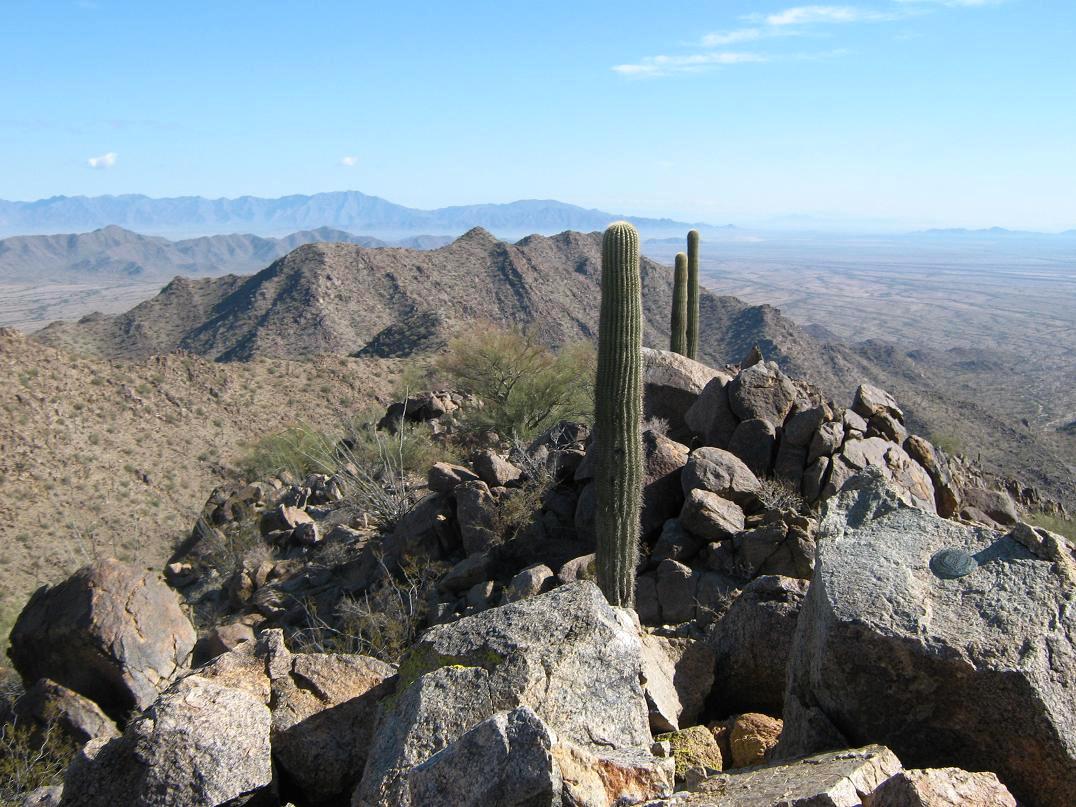
The top was open, some rocks and a saguaro with a big gash on it. I found a register and signed in, the first person here in many years. It had become cloudier by now, although the temperature had warmed into the low 70s. I did not linger. I snapped a few images and started right down.
I walked a long arc around the camping spot, then angled back to my walking-in route. I found a ribbon, then just followed them out to my car. It had been a fast and easy hike.
As I got to the tracks, a train was rumbling by, so I stood well clear and let it pass. It was now nearing 2 p.m. and I felt it was time to call it a day. I was happy with both peaks and ready for a rest.
I drove back into Maricopa, got a snack, checked my texts and emails, then drove into Tempe where I got a shawarma plate from a Greek place I like. I was more tired than I expected to be.
|





|