
The Mountains of Arizona
• www.surgent.net
|
| Piestewa Peak |
• Phoenix Mountains • City of Phoenix • Maricopa County |
|
Date: First time 1997, a hundred-plus times since
• Elevation: 2,601 feet
• Prominence: 1,178 feet
• Distance: 2.4 miles
• Time: 55 to 75 minutes
• Gain: 1,200 feet
• Conditions: Varies
• Teammates: Always a lot of people on the trail
Piestewa Peak is a popular hiker's peak in central Phoenix, always crowded, and even on hot days, there'll be a handful of people on the trail. I hiked this peak the first time in 1997, and have hiked to its top about a hundred times over the years. That's a conservative figure. The truer count may be close to 200. I honestly have no idea how many times I have hiked this peak.
The peak usd to be known as Squaw Peak, but its name was changed in 2008, named after Army Pfc. Lori Piestewa, a Hopi woman from Tuba City (AZ), the first woman killed in combat in the Iraq War. It wasn't hard to get used to the new name. It seemed more appropriate anyway.
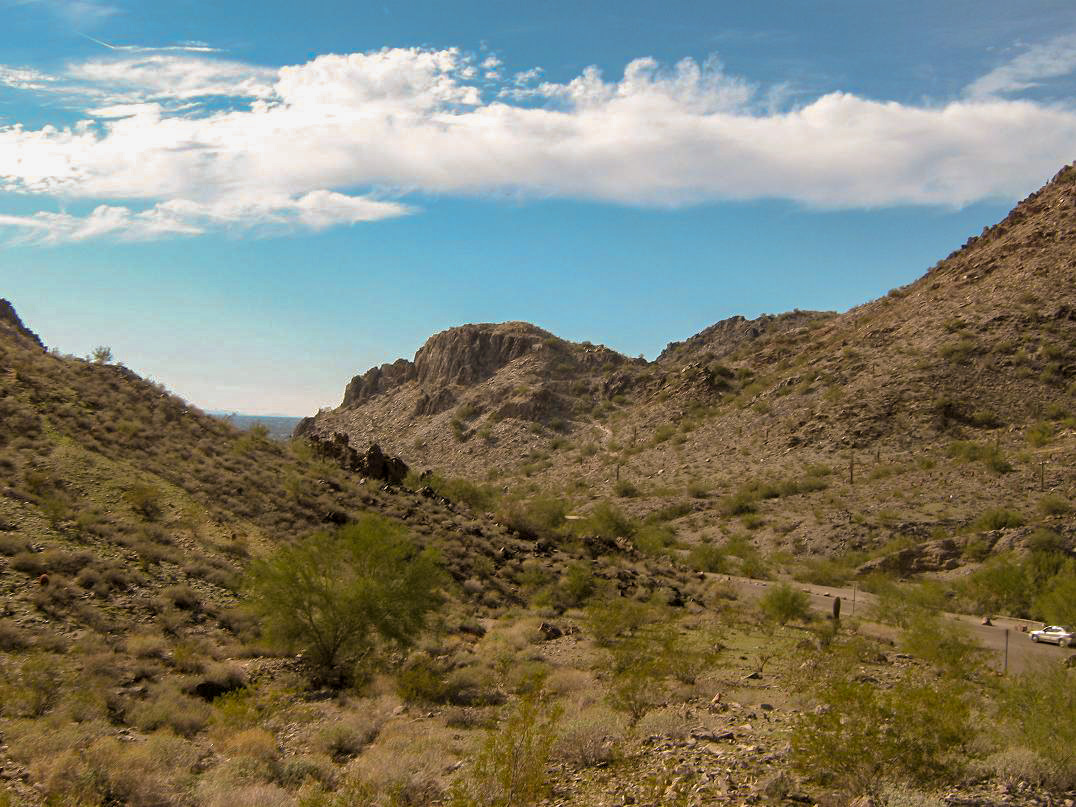
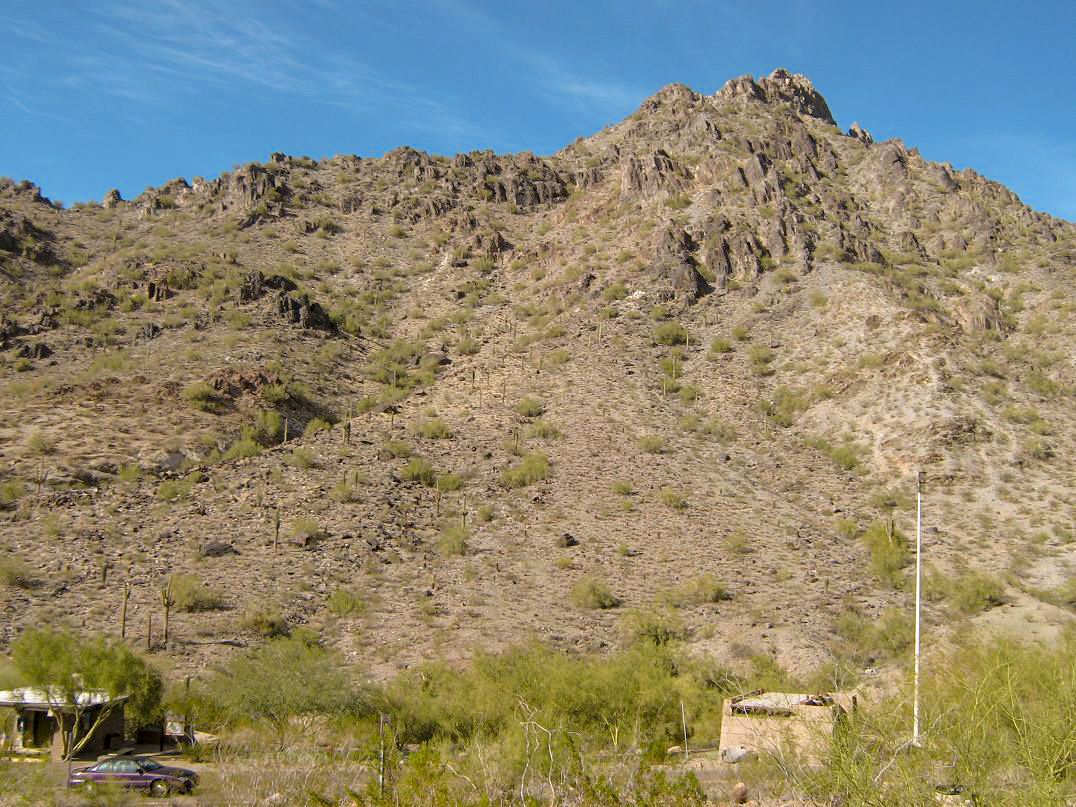
The peak sits within the Piestewa Peak park, part of the Phoenix Mountains Preserve. Access is from Lincoln Avenue nearby the AZ-51 Freeway. On a pleasant winter weekend, the parking lots will be jammed and there may be 200 people hiking the mountain at any one time. Even in summer, when it's over 100 degrees, there will be a dozen of so people on the mountain.
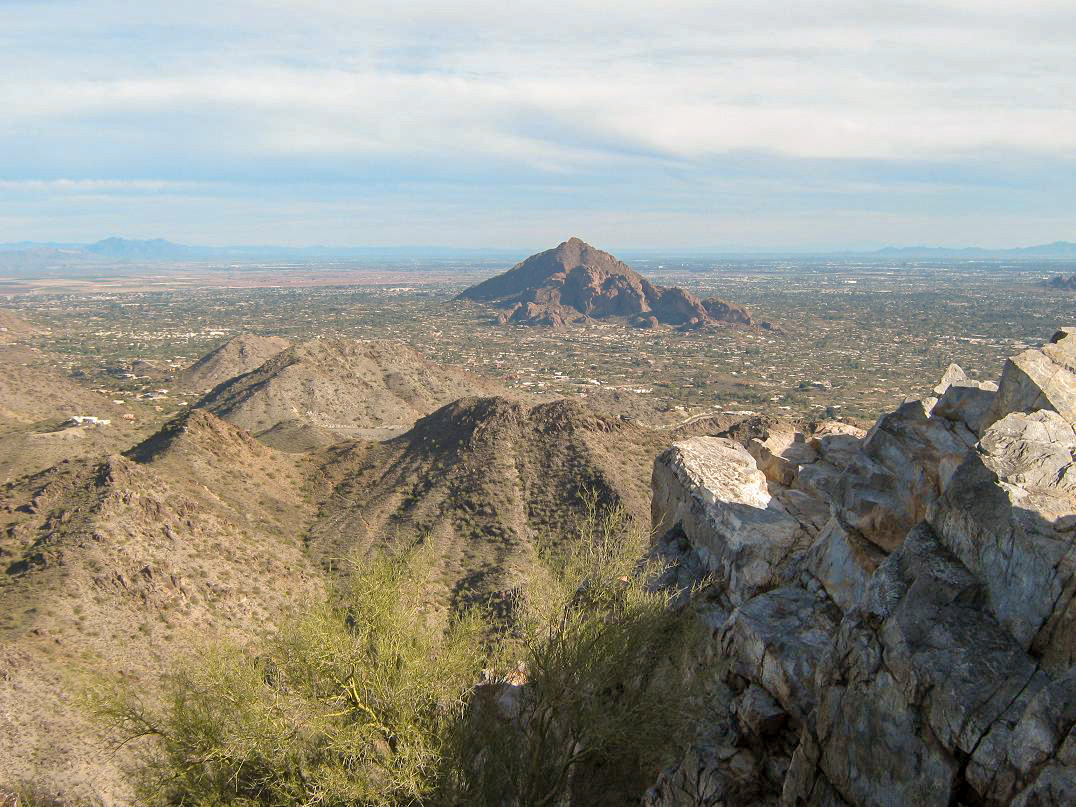
For years, I have shifted my allegiances back and forth between Piestewa Peak and nearby Camelback Mountain. Both peaks have similar hiking statistics, although the trail to Piestewa Peak's top is a little more well-defined than that on Camelback. I may hike Piestewa Peak a dozen times over a three month period, then not at all for a year.
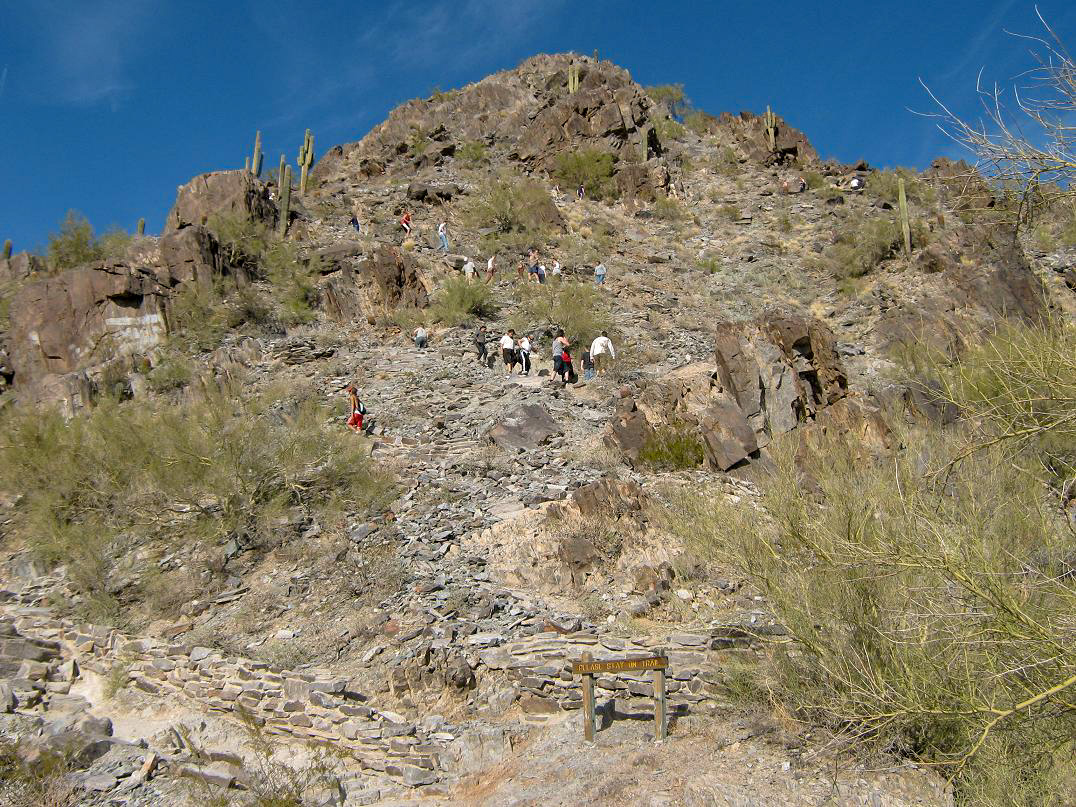
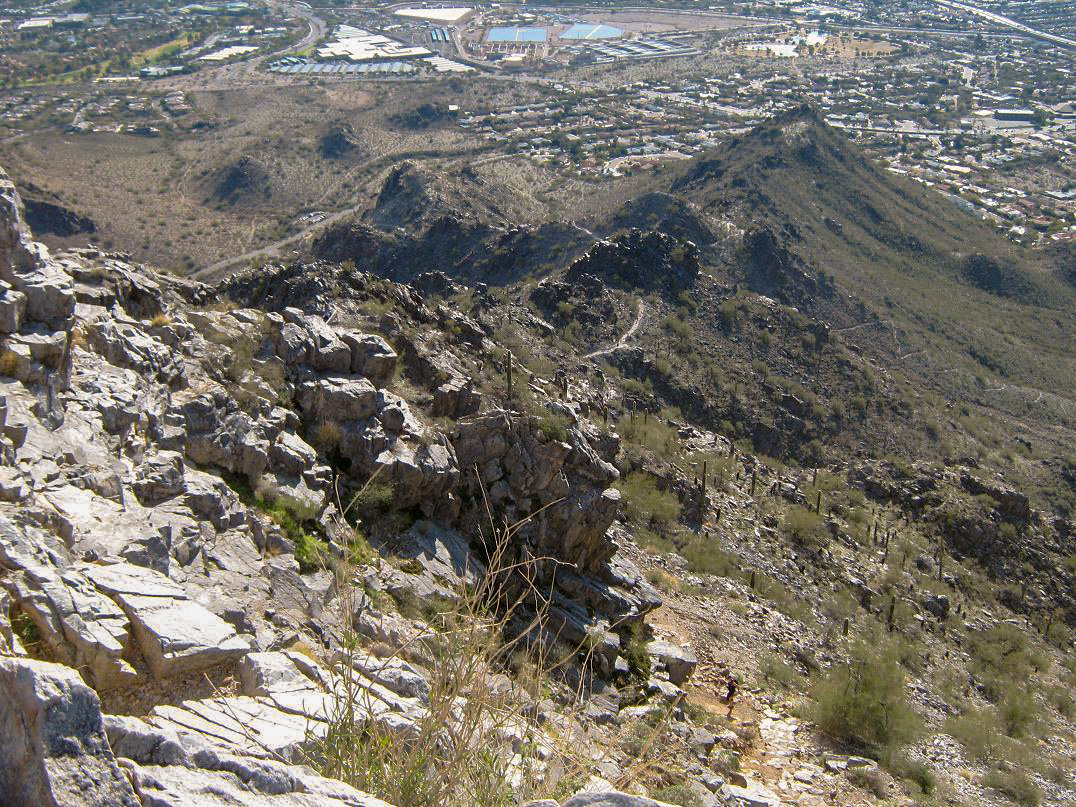
I always take the standard route, which starts at the southern parking lot near the ramadas. The trail is hewn into the rock, with gentle grades and many switchbacks. It's like this all the way up. In places, rock-and-masonry walls have been built to line the route. It's not a wilderness trail by any stretch. Do not come here expecting quiet alone time in the wilderness.
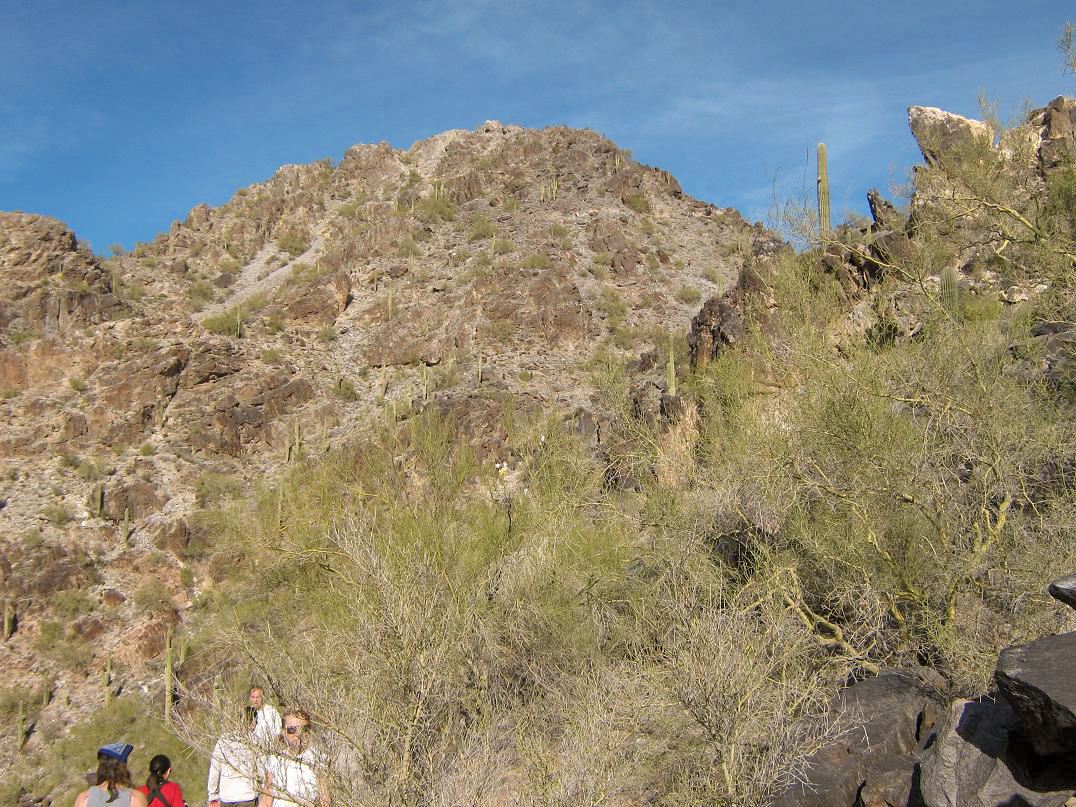
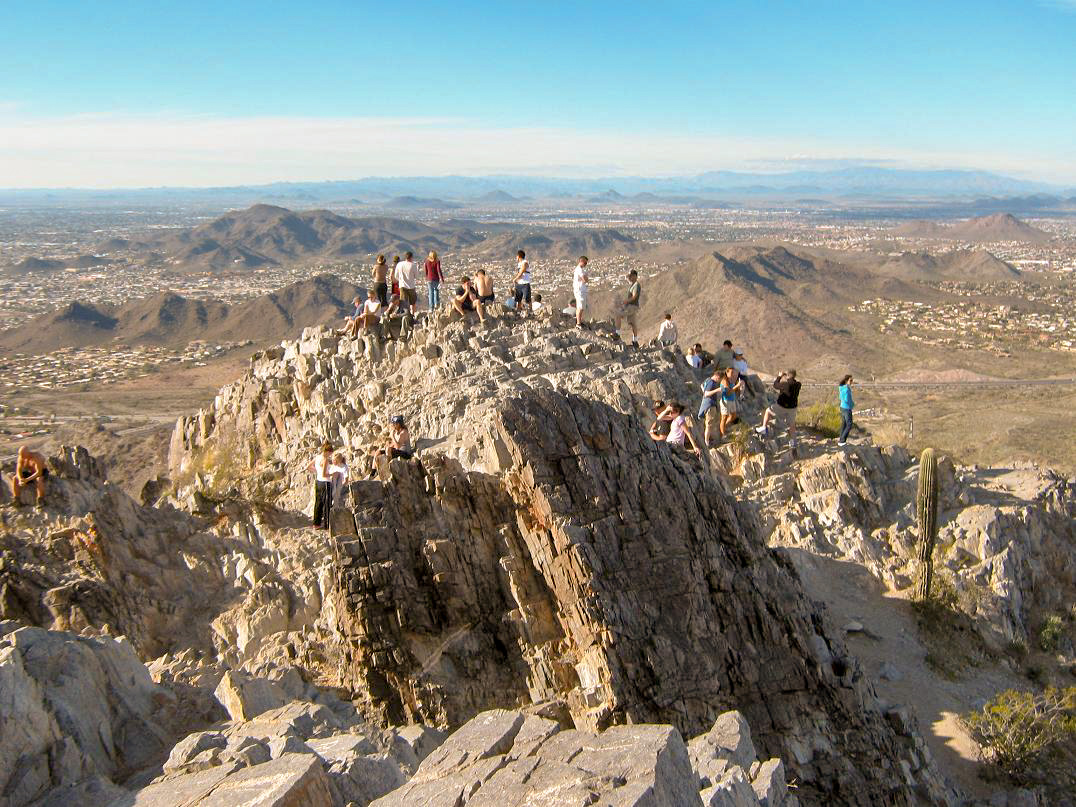
The route gets steeper toward the end, the last hundred vertical feet up rock steps. Then, just below the summit, the trail splits. Most people hang a left and scamper up to a broad rocky bald. The actual summit is to go right, and climb a chute to a saddle, then another ten feet of rock to the top.
In all my years of hiking this peak, the majority of hikers don't go to the actual summit. They take the left turn. The elevation difference between the summit and the more-popular rock bald is about 10 feet. I realize most people are here for the exercise and don't care about ten extra feet. Strictly speaking, very few people actually "summit" Piestewa Peak. This amuses me.
Every hike is enlivened by the sea of humanity on the trails. It's a mix of everyone and everything. There are the superfit types who bound up the peak in 15 minutes. There are families with kids who cry and don't want to be doing this. Once, me and another hiker came across $400 in four $100 bills just lying on the trail. Know what I did? I said, "I don't want any part of this" and walked away. Yes, I actually walked away from $400 just lying there.
I have seen Mennonites (or similar), the women in pinafores and the men in black slacks and long beards. I've seen gang-bangers. In winter, especially during the Bowl games, there'll be a lot of people from out of town in their team's colors. Expect to encounter at least one person loud-talking on their phone. I've run into former students of mine, and colleagues. In summer, I would time my arrival for just before dawn, so that I summitted just after dawn and could be on the downhill before the burners turned way up. My usual round-trip time is 70 minutes. My best time is 55 minutes.
Once, in September 2002 when it was still hot, I did an early-morning hike and was driving home, the time just 6:30 a.m. but already in the 90s. I was on the southbound AZ-51 freeway, near where it merges with the Loop-202. Traffic was very light. I was in the right lane getting ready to exit the 51 and onto the 202. In my rear view mirror I see a car coming up fast behind me, easily over 100 miles per hour, weaving across all four lanes. I watched this person in my rear view mirror and eased onto the right shoulder, which was smart of me because the driver whizzed right into my lane exactly where I would have been had I not pre-emptively got onto the shoulder. Now properly pissed, I had to chase this person.
This person somehow stayed on the fly-over that connects the 51 to the eastbound 202. Now eastbound on the Loop-202, I was on the cell-phone with the police describing the situation. The driver was still pushing 100 m.p.h. and dodging cars along the way. I was speeding myself but not willing to go that fast. Finally, the driver's luck ran out and the car plowed hard into a sedan, forcing the sedan off to the right shoulder, while the speeding driver angled left and spun a couple times, coming to a stop in the far-left HOV lanes. I pulled to the shoulder. At the time I was a certified EMT and I ran to the sedan to check on the occupants. It was two women and a child, about age 10. They were fine, just shook up. Their car was on the shoulder out of traffic, they were conscious and with no obvious injuries. The cab was intact, all the damage being at the car's rear. I stayed with them until medics arrived, which was just a few minutes.
Meanwhile, the other car and its driver just stayed put. I yelled over to the driver, a young female, to stay put, do not move. I was not going to cross traffic to go attend to her. She was staring at the whole scene. A couple other people had pulled off to the side, and even though traffic was light, there was the speeder's car in the road and debris in the road, so we were motioning for people to slow down, to avoid more accidents if they were to hit the car or the debris.
One of the cops had cordoned off the speeder's car and while talking to another cop, was told the driver had, or was in the middle of, a diabetic "episode". The driver never moved, never stopped gazing. Even if I cut her all the slack in the world, what she did was absolutely horrible. She almost broadsided me back on the 51, and almost injured or killed the three people in the car she hit, not to mention the others she somehow avoided. All I wanted was a damn hike to do and go home.
In recent years, I haven't climbed Piestewa Peak very much, down to about one time per year. In December 2022, I hiked it on a lovely afternoon. The trail was far more crowded than I have ever seen it, and I've seen it get crowded. For starters, it's college football Bowl season, so there are more people in town than usual, partisans for their football team, and many of them want to hike the trail & peak, and I certainly don't blame them.
It was also just a lovely day all around, temperature about 70 degrees, sunny and calm. I found a spot and parked. In the past few years, the whole area was completely redesigned to better accommodate the crowds, with more parking, better toilets, and just better all-around infrastructure, such as sidewalks, a bridge to access the trail, things like that. The trail itself has been shored up in many areas with newer stone-&-mortar walls, in places where erosion was becoming an issue. Overall, it's far more attractive than it used to be.
In the past, one of the aggravating things was looking for a spot to park. This, ironically, acted as a limiting factor in the number of people on the trails. With more parking, more people can be on the trail, which probably partially explains why there were so many more people than I recall from past times up here.
Not a single person that I encountered on the way up or down was "problematic". Everyone was cool. That says a lot when you can have a few hundred people in close quarters and essentially no one was a jerk. It's a self-selected crowd. Those who are jerks by nature probably gravitated toward a bar in Scottsdale, rather than hike.
My hike upward went well. I've hiked the trail so many times, and even with a year between my last hike and now, I stiill remember every (or 90% of every) twist and turn, nook and cranny, strategic places to place my feet. I was moving at a steady pace, deliberately trying to keep up a good pace. I had no problems with bottlenecks until the very top, where things got crowded.
One thing I noticed is that the rock seems slicker these days, which it may be. I'm thinking that decades of people hiking have "sanded" these rocks until they are smooth and less frictiony. There were a couple spots where I didn't feel so confident of my footing whereas in the past, I had no issues.
At the very top, I did my usual right-turn and scampered up the 20-foot chute to place me on the tiny saddle below the real top. Just then, a younger woman was coaching her son up these rocks. He was scared, but he did it. He was young, maybe 7 or so. I stood back, and watched, happy that he did it. I then did my usual scamper up and sat on a random summit rock. Another Piestewa Peak summit for me.
The downhill hike, this is where it got crazy-crowded. Those rock-steps below the summit are narrow, so it's not practical to pass someone, and it's not good manners either. But I was like 15th in a long line, so it went real slow. It was like this for another few hundred feet, and at one point, the whole parade stopped as a family were having their photo taken at one narrow point. The woman taking the photo even said "I like to take multiple images". I may have sighed.
Anyway, once down a little more where the trail widens and there are more bypass options, the bolus of people was able to spread out more, and I was able to keep up a good pace for me. I was not intending to set any speed records. I just wanted to move at a steady rate. According to my thing that tells time, I had started my hike at 12:15, made the top at 12:47 (a 32-minute ascent!). I was back to my car at 1:30, a 75-minute round trip. About 10 or 15 minutes of that includes being stalled in the crowded bits or being forced to take it slow. The last thing I wanted to do was tumble in front of all these people.
So, yeah, I've been here and done that nearly 200 times over 25 years. But it's still a great hike. I always come down feeling great, and along with Camelback Mountain, it is arguably one of the best urban hikes in the country.
|
|