
The Mountains of Arizona
• www.surgent.net
|
|
Doubtful Peak formerly Peloncillo Mountain |
• Peloncillo Mountains • Peloncillo Mountains Wilderness Area • Cochise County |
|
Date: March 1, 2009
• Elevation: 6,520 feet
• Prominence: 2,193 feet
• Distance: 6 miles
• Time: 5 hours, 15 minutes
• Gain: 1,800 feet
• Conditions: Clear and windy
• Teammates: Scott Casterlin
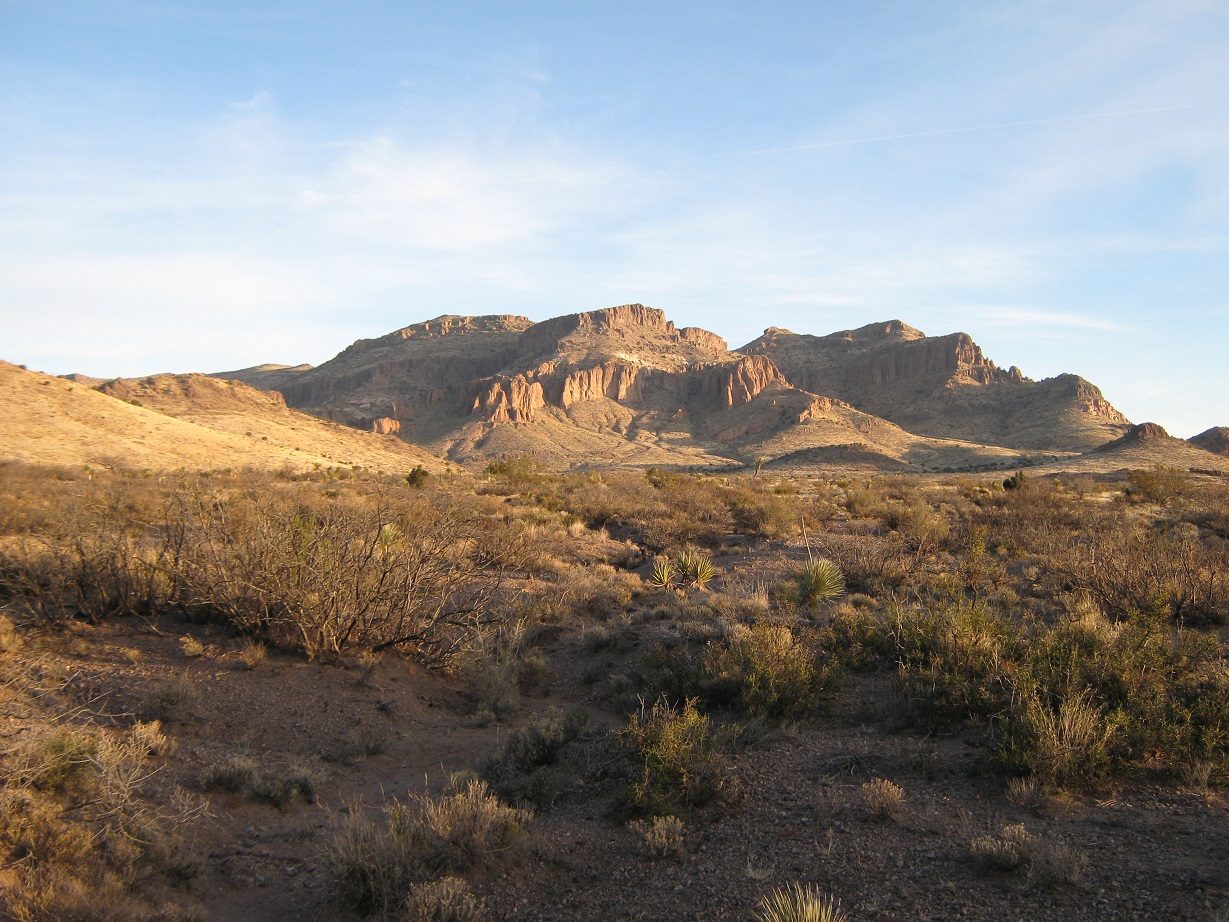
This peak has no official name, but it is the highest point of one batch of the Peloncillo Mountains, which run along the southern Arizona-New Mexico boundary. The summit of this peak lies barely within Arizona, no more than a mile, and we would be approaching the peak from the New Mexico side.
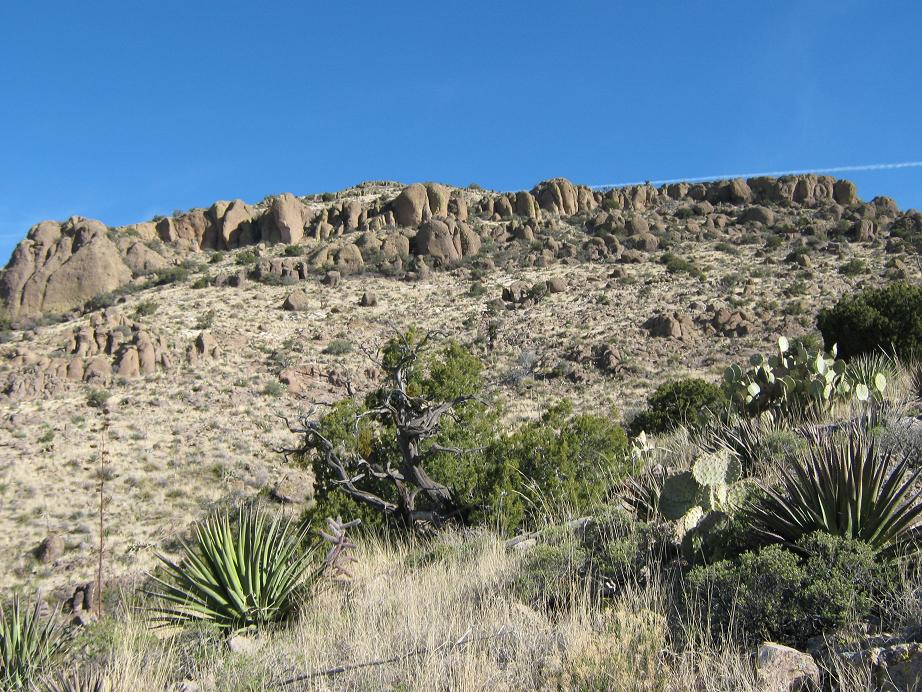
Compared to surrounding "sky island" ranges in this part of the country, the Peloncillos seem out of place, being a conglomeration of smaller peaks and hills, not high enough to be covered over in thick forests. The name, Peloncillo, is a derivative of the Spanish word for bald, which is a reasonably apt description of the peaks. Our peak of interest featured plenty of cliffs and a pallisade of rounded tuff bands, so it had its own sort of attractiveness.
Scott Casterlin proposed this peak a couple months ago while we were on another hike. Since he was very close to completing the Arizona list of 73 peaks with 2,000 feet of clean prominence, he wanted to climb the last handful of peaks on the list before long. The distance, nearly 250 miles, puts a damper on building up the motivation to go climb it, but since Casterlin was interested, then yes, so was I. It was clearly a good opportunity to make the long effort for this unheralded summit.
I left home about noon, ran some errands, picked up Scott in Tucson and by 3 p.m., we were on our way east along Interstate-10, making good time. We passed into New Mexico, crossing the Peloncillo Mountains at a low pass just inside the state line, and exited at milepost 3, the ghost town of Steins. Here, we went north on a graded road (called A-12 on the New Mexico atlas) for about 10 miles, then hard left (southwest) on another road into Doubtful Canyon, back toward the Arizona boundary.
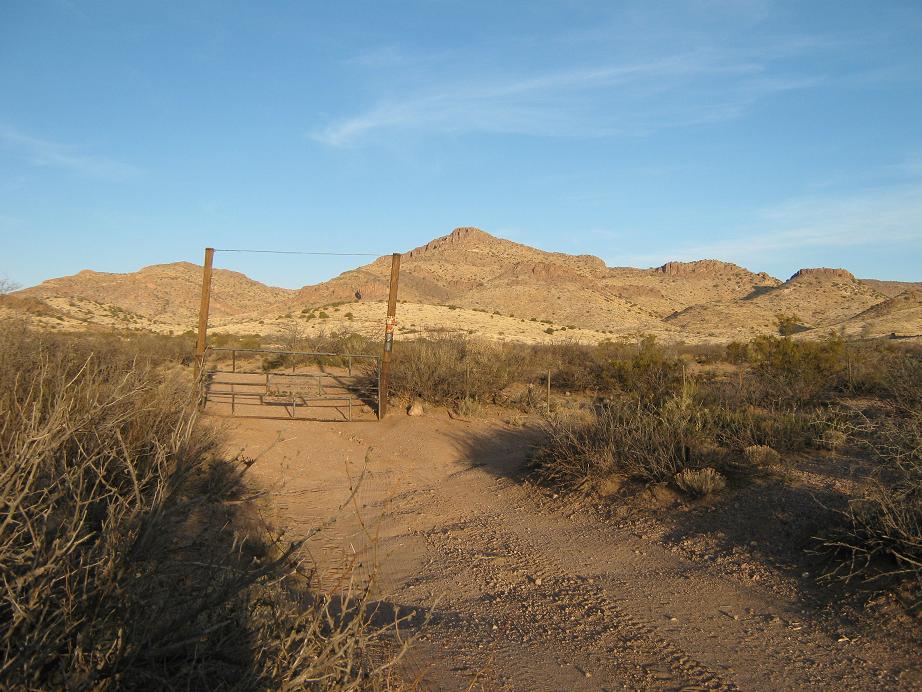
By now it was 6 p.m. and into sunset, having just enough light to manage the last portion of the road. The road is in fine shape for most of the route. When it comes to a windmill near a small set of buildings, we went right on the public right-of-way through a sandy wash. There was a group camping at this windmill with a big bonfire going. We emerged from the wash and followed the rough road another half-mile to a fence and gate, this being the Arizona-New Mexico state line. We parked off the road in a clearing and set up camp as darkness fell. We had no clouds, a crescent moon and Venus in the western sky, with mild conditions.
Camp was somewhat eventful: it seems a dog from the other set of campers was lost or hurt in the hills below Steins Peak, howling for help. We could also hear people calling for the dog, all this in the dark. They seemed to be successful because in time the dog quieted down and we didn't hear voices any more. Then around 8:30 p.m., another truck comes rolling up: the landowners of the ranch just beyond the gate inside Arizona. They were curious about our presence but very friendly, and did not seem to mind us being there at all. They said they get hikers, rock hunters, campers and so on, all the time. We chatted about 15 minutes and learned a little history while at it.
Doubtful Canyon is so named because of the old Apache Raiders of the 1850s-1870s. If you passed through here, it was doubtful you'd make it. This area was also on the Butterfield Stage Route, and an old grave can be found about a half-mile south of the road if you know where to go (we did, after the hike). Scott is a history fan and knows a lot of this stuff by heart, and was out here ages ago seeking out the various ruins of the Butterfield Route. The landowners usually do not grant public access onto their property, but told us we could walk part of the road if we preferred. We were already planning on bypassing their property altogether by sticking to fence lines, staying on BLM land as much as possible. We turned in around 9, me in my truck, Scott on the ground. During the night the wind blew heavy, knocking things over and making noise, but by 7 a.m. it was still again, cool and clear.
We started hiking at 7:15 a.m. and went north along the fence separating Arizona and New Mexico. The terrain here was easy, mostly open grasses with some brush, sometimes descending into and out of arroyos. We came to a junction of fences and crossed west into Arizona, then continued north, crossing another fence presumably back onto BLM land. There were far more fences than on the map and we could only guess if we were on private or public land as there was no signs anywhere.
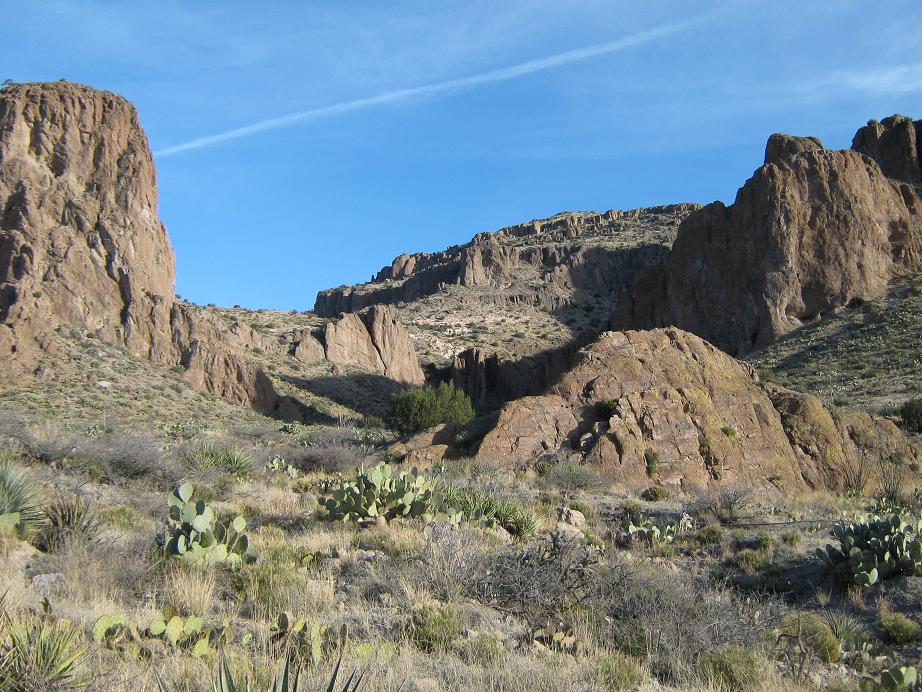
We trended west into Arizona and worked our way into a prominent side canyon called Little Doubtful Canyon, a mile and a half from the truck and less than an hour after setting out. As we entered into the canyon, we could see breaks in the cliffs and from here we were able to eyeball some promising routes. In the canyon, we were in shadow and it was much cooler, the breezes funneled into a strong gale at times. More than once my hat almost blew off.
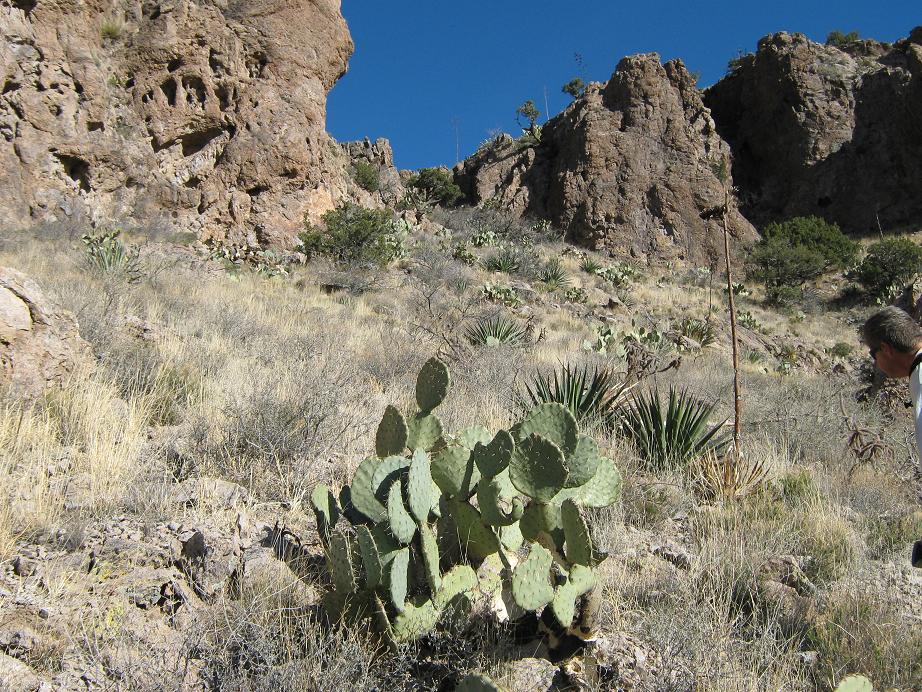
Looking into Little Doubtful Canyon, this is what we saw for a route: immediately in front of us were three very prominent tooth-shaped rocks, the biggest on the right, the smallest on the left. Just to the left of the smallest rock seemed to be a promising weakness, so we climbed out of the sandy drainage and up the slopes, which were rocky with prickly-pear cactus and agave. The slog up this slope to the base of these rocks went quickly and easily, and yes, our hunch was correct: behind the left-most rock was an easy ramp of rock stairs, some brush and cactus, but easy enough to hike where hands weren't needed. We walked up this section gaining about 20 feet, then back onto more slope, and gained another fifty feet to surmount a ridge, the first of the main cliffs bands now successfully behind us (or below us, literally). We took a break here for water and snacks.
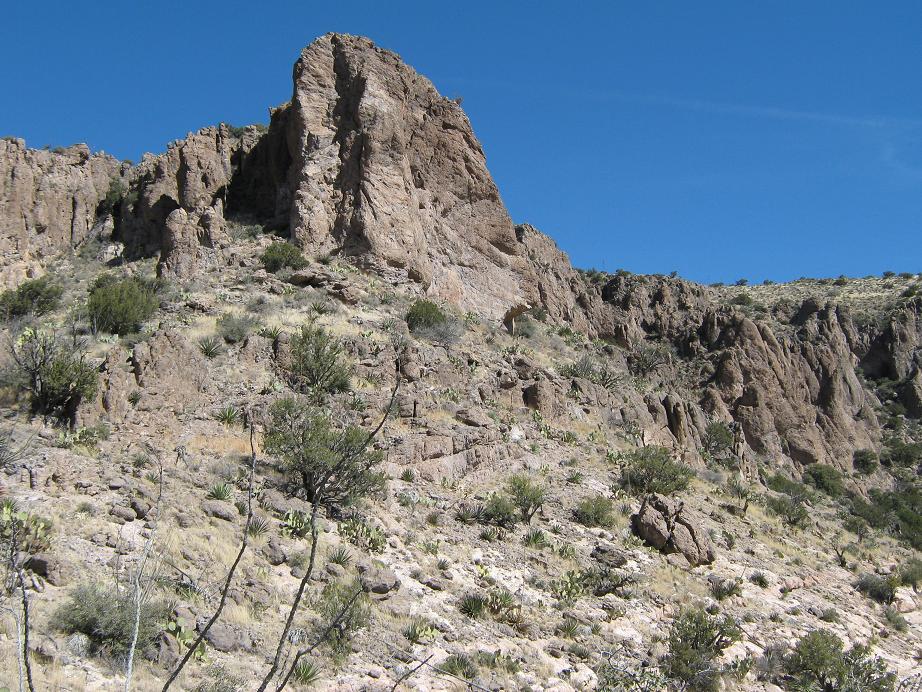
The next section was a cliff wall directly to the east, around the back of which a brushy ramp seemed to lead high up and possibly above these cliffs. We hiked up easy slopes toward a small cliff band of dark-colored rock. We traversed below this cliff band for a few dozen feet then at a weakness, wormed our way up onto the sloping terrain above it, and directly below the bigger cliff above us. This cliff is notable for a distinct overhang of rock on its lower right (east) side (see photo at left). We scampered up toward this little overhang, then around it to the main ramp that (we hoped) leads to the top of these cliffs.
This section was steep and occasionally sloppy with loose rock and gravel, but not exposed in any way. As we climbed higher we came to the headwall, so to speak, of this ramp, notable for a mature juniper growing right within it. Two clefts in the rock allow for a choice in passage to the top. I went left, working up the easy class-3 rock and gaining about 15 feet to gain the top. A small cairn is here suggesting others have come this very way, and also notes where these clefts are located for the descent.
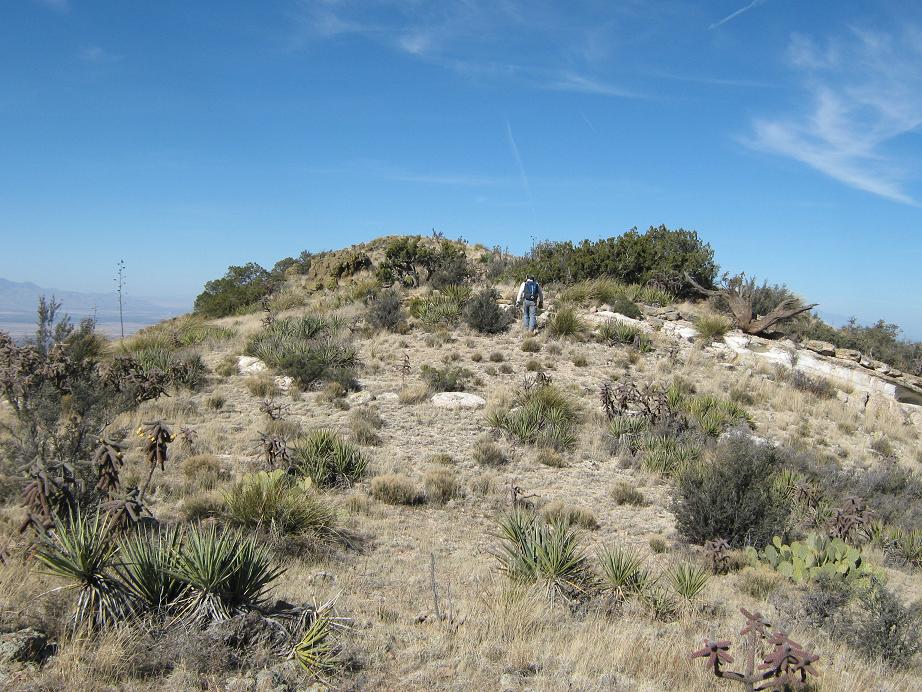
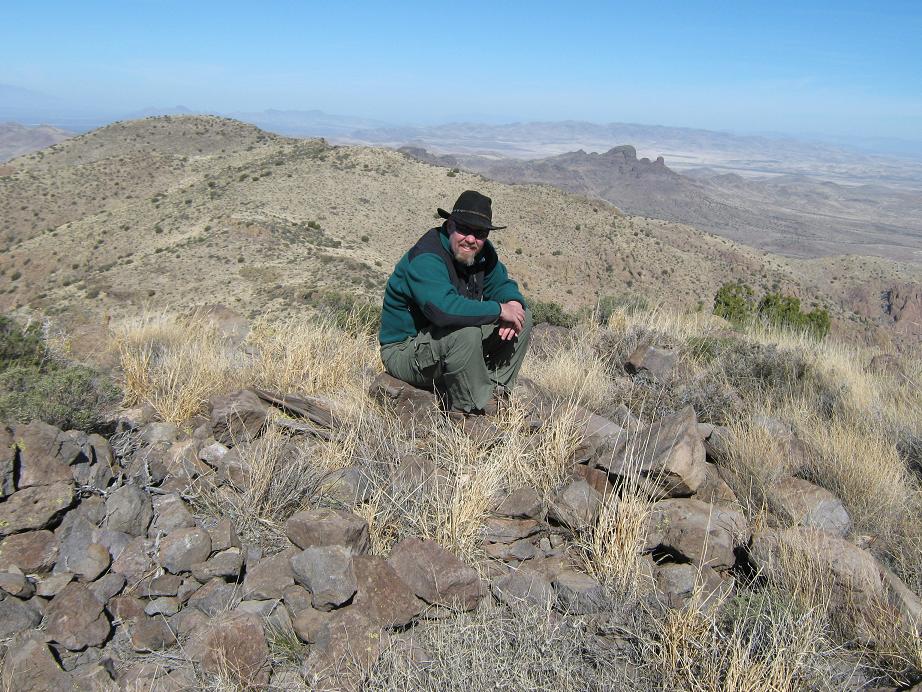
Now we were above the largest of the cliff bands, and the summit was now much closer, surrounded by small rounded marble-like barriers of tuff rock. We aimed for the rocks south of the summit, then worked our way through these rocks and one fence (a property boundary we surmise, certainly not here to guard against cattle). The last obstacle was to get up the remaining vertical 20 feet of vertical through any of a number of clefts in the surrounding tuff. Scott found one cleft he liked and went for it. I walked around back (northeast) and found another cleft that, other than some brush in it, sloped gently with all sorts of hand holds. Soon we were both above the rocks and the summit was an easy 200-foot walk away, a small little hill on top the summit ridge. We arrived on top at 9:45 a.m., two and a half hours since starting out.
The views were spectacular as always, especially today with single-digit humidity levels and no clouds. In our immediate vicinity were the other peaks of the Peloncillos. To the south were the Chiricahuas and its satellite peaks such as Silver and Portal. Big Mount Graham was visible to the west, as was Dos Cabezas. South we could spy distant Animas Peak and the more impressive Big Hatchet, both in New Mexico. Due east in New Mexico was the Lordsburg Playa in the basin below us, and the Burro Range off to the northeast. The Gila Mountains formed the far northeast horizon. The only downside was the wind, which was fierce and very uncomfortable, so we took shelter below the summit, guarded by the rocks.
We spent about 20 minutes up top before heading down. We chose to retrace our route going down, and the various little cliff sections went very well, and we made excellent time. We were below the cliffs and into Little Doubtful Canyon within an hour. Scott's ankle was bothering him so we chose to walk the ranch road out instead of following the fences cross-country. The walk out to my truck took just under two hours, arriving to my truck slightly after noon. Another truck was parked nearby, four older men poking about the area, so we talked to them. They were members of a hiking club from Silver City, here to hike the Butterfield Stage Route and check out the grave marker mentioned earlier. Back at the truck we had a lunch, then set out for the short hike to the grave marker ourselves.
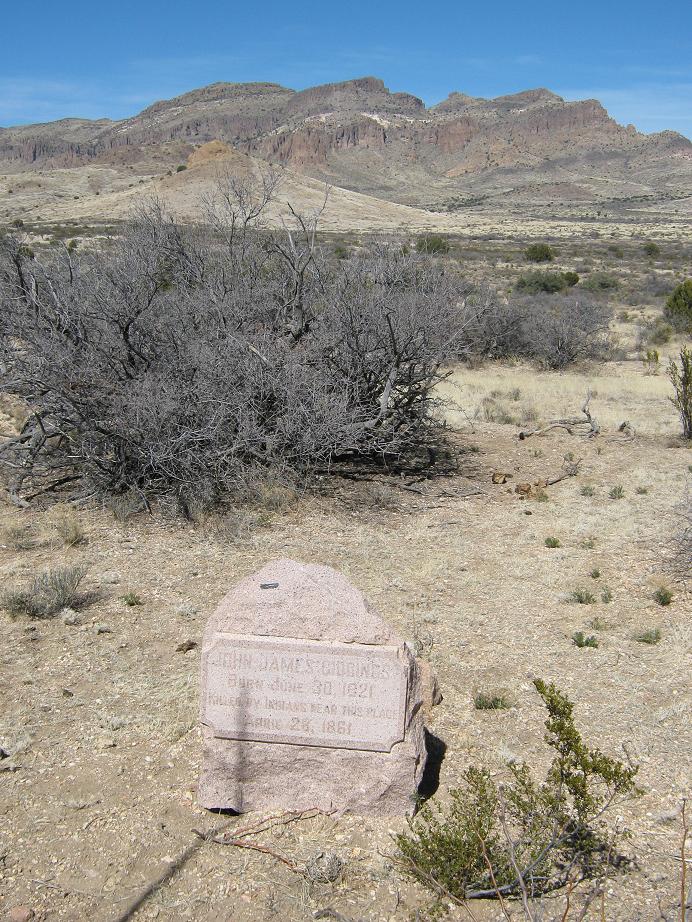
The hike goes south along the state line fence for about 300 feet (and a gain of about 50 feet) to where the fence line turns right. We walked west and actually passed the grave at first. Coming back Scott found it, some surveyor ribbon on nearby brush helps mark the spot. The grave is for a fellow named Giddings, killed by Apaches in 1861 presumably as he was heading east to fight in the Civil War. The headstone is newer, probably within the last 20 or 30 years, and probably the work of a local historical group. It was interesting to find this unique little spot, and we spent a couple minutes here trying to surmise what it was like here nearly 150 years ago. Probably not a whole lot different than today
Finally, close to 2 p.m., we started the drive out to the highway, which took less than an hour to get to Steins, then another couple hours including a gas and snack stop in Willcox to get to Scott's place in Tucson. After getting all his stuff out of my truck, I drove home, arriving just as it was getting dark.
This peak went well and was much less demanding than I had expected. The route through the cliffs was straightforward and at no time did I feel unsafe or in over my head. I did get the usual souvenirs: scratches and a few cactus spines in various points of my skin, some not discovered until after I had showered.
 This is a screen-capture of the United States Forest Service page for the Peloncillo Mountains. The banner image is mine. Compare it to mine in the sidebar.
Update: May 2023: The Arizona Board of Geographic Names has approved the naming of this mountain to Doubtful Peak, its new official name. |
|