|
This is a general cubic polynomial equation: Instead of directly tackling the polynomial in this form, first consider a "smaller" form, then work backwards to show how it can be applied to the general form. This smaller form is It is missing the x2 term. This is a depressed cubic. Any general cubic polynomial can be depressed by a horizontal shift of the input variable, which will be discussed later. Assume the solution of the depressed form is Cube both sides and expand: Rearrange terms slightly: Since x = m + n, the equation is now Example: Solve x3 = x + 1. Solution: Set 3mn = 1 and m3 + n3 = 1. In the first equation, isolate n and substitute into the second equation: Simplify the second equation by clearing fractions and collecting terms to one side:
27m6 + 1 = 27m3
27m6 − 27m3 + 1 = 0.

Thus, 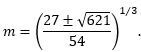
Since n = 1/(3m), 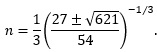
Lastly, since x = m + n, the solution to the equation x3 = x + 1 is 
Using the positive radical gives: 
A calculator shows that this is x = 1.324717957... . 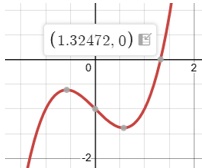 Graph of f(x) = x3 − x − 1 with root highlighted. Note that the negative radical form gives the same result: 
If C is a root of the equation x3 − Ax − B = 0, then the cubic expression can be factored as 
The quadratic formula gives the two other roots: 
In this example, the other two roots are x = −0.6623589785 ± 0.5622795116i, both Complex. In general, by setting 3mn = A and m3 + n3 = B, the general form can be found, as follows: Solve for n in the first equation: Substitute into the second equation, and simplify by clearing fractions and collecting terms to one side: m3 + (A/(3m))3 = B m3 + A3/(27m3 ) = B 27m6 − 27Bm3 + A3 = 0. Using the quadratic formula gives 
Thus, 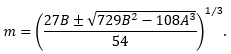
Since n = A/(3m), this gives 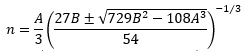
The general solution is 
As shown in the first example, either form with the positive or negative radicals gives the same result. Simplified, the above form is 
Example: Solve x3 = 2x + 3. Solution: Note that A = 2 and B = 3. Thus, 
On a calculator, this is x = 1.893289196 ... . 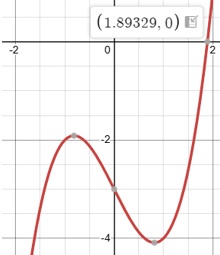 Graph of f(x) = x3 − 2x − 3 with root highlighted. Example: Solve x3 = −x + 2. Solution: Note that A = −1 and B = 2. By inspection, x = 1 is a solution. Will this method work? Substituting gives 
On a calculator, this is x = 1. It worked. However, it is not obvious this long expression is 1 in disguise. This illustrates a problem with this method. It returns valid results, but in a form that can be hard to decipher. There is no easy way to simplify this expression. Example: Solve x3 = 7x + 3. Solution: Note that A = 7 and B = 3. Substituting gives 
The radicand is negative, but interestingly, using a calculator gives x = 2.838469252 + 0i. The answer is Real, with no imaginary part. 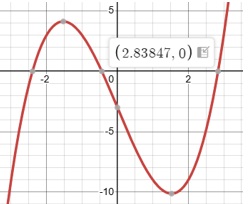 Graph of f(x) = x3 − 7x − 3 with root highlighted. Observe that this method gives the largest possible Real solution. Suppose the graph is reflected across the y-axis. This is done by substituting −x for x, and simplifying. The equation x3 = 7x + 3, after substitution, becomes (−x)3 = 7(−x) + 3, which is −x3 = −7x + 3, or x3 = 7x − 3. This is the same graph as the above but shifted up 6 units. Its roots will be negative of the three roots of the above graph. Using the formula, only one small change happens: B = −3: 
A calculator gives x = 2.397661541 + 0i. Thus, another root of the original equation is the negation, x = −2.397661541. 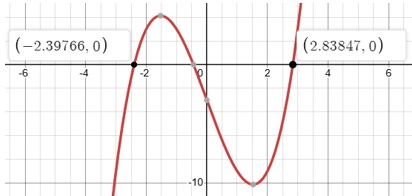 Graph of f(x) = x3 − 7x − 3 with another root highlighted. Referring to the formula for x,
The formula always gives a Real result, even in cases when the radicand 81B2 − 12A3 is negative. When the radicand is positive, the graph of f(x) = x3 − Ax − B crosses the x-axis once, and has exactly one Real solution, the other two being Complex conjugate roots. When the radicand is zero or negative, the graph of f touches the x-axis twice (one root a repeated root) or three times (three Real roots). Forcing the radicand to be positive gives This is equivalent to Note that 81/12 = 27/4 after simplification. What does this actually mean? Is there a visual way to justify this? There is. The graph below shows the basic cubic function y = x3 with a generic linear graph y = Ax + B. Note that A is the slope of the line. 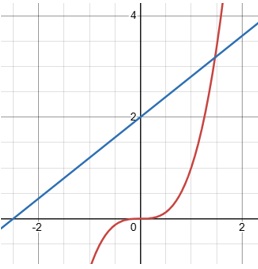
In this configuration, the graphs intersect once. Thus, the function f(x) = x3 − Ax − B will have one Real root and two Complex conjugate roots, and the radicand in the formula will be positive. Suppose the linear graph moves downward, as shown below: 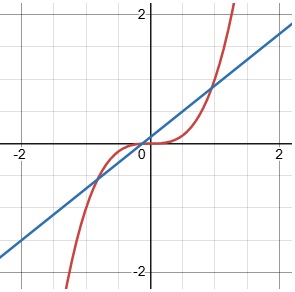
In this configuration, the graphs intersect three times. The function f(x) = x3 − Ax − B will have three Real roots, each of multiplicity 1 (that is, all unique). But more importantly, the radicand in the formula will be negative. It is the B value that governs the line's y-axis intercept. Assume that A (the slope) is kept constant. Now find bounds for B that will ensure the radicand is positive and that the function f(x) = x3 − Ax − B has exactly one Real root. It is known that this happens when A3/B2 < 27/4. Below, the graphs of the line y = Ax + B touch tangentially to the graph of y = x3 (the two black points). Where these lines cross the y-axis (the orange points) form an interval. If B is within this interval, then the radicand in the formula is negative and function f(x) = x3 − Ax − B has three unique Real roots. If B is outside this interval, then the radicand is positive and the function f(x) = x3 − Ax − B has exactly one Real root. 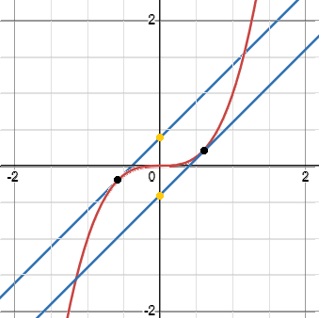
The derivative of y = x3 is y′ = 3x2. Now find the x-values for which the slope of the tangent line is A; that is, solve This gives Consider the case for which x = (A/3)1/2. The coordinate on the graph y = x3 is ((A/3)1/2, (A/3)3/2). The line has slope A, so using the point-slope formula for a line, y − y1 = m(x − x1), and substituting gives 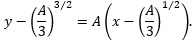
Distribute and isolate y: 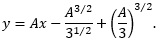
The two constant terms can be simplified: 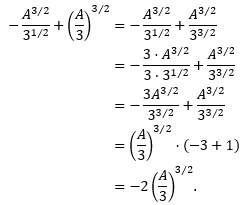
Thus, the equation of the tangent line is 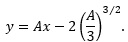
The value y = −2(A/3)3/2 is the y-intercept of the lower of the two lines. By symmetry, the value y = 2(A/3)3/2 is the y-intercept of the upper of the two lines. This results in two statements:
Consider the inequality B > 2(A/3)3/2. It can be rearranged slightly. Divide by 2: Square both sides: Clear parentheses: Divide through by B2 and A3, and rearrange: This was the same inequality derived from the radicand directly. Note that using any of the other expressions above will result in this same inequality. Lastly, note that if A is negative, then the above inequality is always true and there will only be a single Real root. Consider the case when the radicand is 0: Example: Solve x3 = 3x + 2. Solution: Note that A = 3 and B = 2. Substituting gives 
This is just 1 + 1 = 2, which is a solution that can be easily checked. 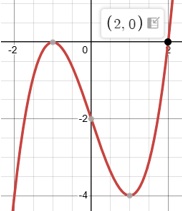 Graph of f(x) = x3 − 3x − 2 with the root at 2 highlighted. The expression x3 − 3x − 2 factors as (x − 2)(x + 1)2, so that x = −1 is the other root, with multiplicity 2.
The general cubic equation is given by The leading coefficient can always be divided out, resulting in a simpler form, Out of laziness, b/a is renamed b, c/a is renamed c and d/a is renamed d in the above equation. There is never any reason to not divide out the leading coefficient first. The quadratic term can be removed by a horizontal shift. Let x = w + h, where h is the shift to be determined. Substituting, Expanded, this is: The terms are recollected in powers of w: To remove the quadratic term (w2), force 3h + b = 0, which means that h = −b/3. Thus, to depress a cubic equation of the form x3 + bx2 + cx + d = 0, set x = w − b/3.
Example: Find the Real root of x3 + 6x2 − 7x + 10 = 0. Solution: Here, b = 6, so h = −6/3 = −2. Substituting this into the expanded form above, and noting that c = −7 and d = 10, results in: Which gives This is now a depressed cubic: The graph of the depressed cubic y = w3 − 19w + 40 is the graph of the original, y = x3 + 6x2 − 7x + 10, shifted to the right by 2 units. Now solve w3 − 19w + 40 = 0 by writing it as w3 = 19w − 40 and using the formula. Here, A = 19 and B = −40: 
This is w = −5.170679557. The original substitution was x = w − 2, so that x = −5.170679557 − 2 = −7.170679557. This is the lone Real root of the original cubic equation. 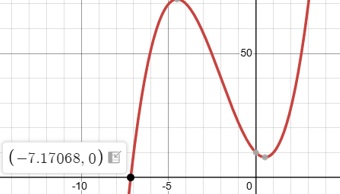 Graph of f(x) = x3 + 6x2 − 7x + 10 with the Real root highlighted.
|